From the ACE database. Researched and checked against published sources.
Victor Houteff
1885 to 1955, Shepherd's Rod and Davidian Seventh-day Adventists, active in Los Angeles and at Mount Carmel near Waco, Texas
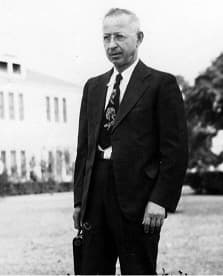
Unknown author, Public domain, via Wikimedia Commons
43/100
ACE Score: 43/100
Medium on the scale. An index, not a percentage.
35Low
How total and coercive the leader’s power was.
53Medium
How devoted to and dependent on the leader followers became.
40Medium
How hard it was to leave.
(rule-based):Pattern: walls low enough (Bubble Score under 5) for followers to leave fairly easily. A label for these scores, not a forecast. The summary and caveats describe what actually happened.
Scores are an interpretation of published sources using the ACE scoring guide, not findings of fact. Inclusion does not classify anyone as a cult. Disclaimer
Victor Houteff, a Bulgarian immigrant, began teaching his own interpretation of prophecy in a Los Angeles Seventh-day Adventist church in 1929 and published it as The Shepherd's Rod. Removed from church membership in 1934, he moved with a small group to Mount Carmel near Waco in 1935. He taught that 144,000 purified Adventists would soon be gathered to Palestine to set up God's kingdom. His movement is the ancestor of the Branch Davidians, but Houteff himself led a disciplined, non-violent community.
In academic terms, houteff's Davidians show strong temporal closure and moderate epistemic and spatial closure, with low existential closure. A written constitution and executive council gave the movement more structure than most prophet-led sects.
Where scholars disagree
The case that the framework fits
A self-proclaimed messenger, a separated settlement and a strong end-time expectation are features that later enabled the far more destructive Branch Davidian community. Newport traces clear doctrinal continuity from Houteff to Koresh.
The case that it does not fit, or overstates
Houteff built a rule-governed, non-violent community with a constitution and missionaries, and he never set a date or demanded sexual or total control. Treating him through the lens of Waco reads later events back into a very different leadership.
The five walls
4.2 of 10
- 5
1.
Who decides what is real?
Houteff's writings were treated as present truth needed to purify the Adventist church, and mainstream Adventist leaders were seen as apostate. Members were taught to avoid worldly influences, though outside information was not censored by force.
- 4
2.
Are friends and family outside the group cut off?
Families at Mount Carmel lived in a structured community with its own school and rules on dress and diet. Ties to non-Davidian Adventists were strained, but not forbidden.
- 4
3.
How hard is it to physically leave?
Mount Carmel was a rural settlement outside Waco where residents worked for the community. Leaving was possible, but residents depended on it for housing and work.
- 6
4.
Is an apocalypse or a destined triumph always near?
Houteff taught that the ingathering of the 144,000 and the establishment of a physical kingdom in Palestine were near. Mount Carmel was understood as a temporary staging post, which shaped daily life.
- 2
5.
Does the group decide who deserves to live?
The mainstream Adventist church was described as Laodicean and in need of purification. No dehumanisation of outsiders or violence against critics is recorded.
Debt, dependence and harm
5 of 10, medium
How much do followers feel they owe?
Members paid tithes to the movement and residents contributed labour to farming, printing and building at Mount Carmel. Some moved their families and savings to Texas.
5 of 10, medium
How far does everything rest on one person?
The 1943 Leviticus of the Davidian Seventh-day Adventists set out a constitution, by-laws and government, and the movement was incorporated. After his death an executive council accepted his widow Florence as leader, though the movement later fragmented.
0, little harm, or balanced
When the system turns violent, where does the harm go?
No violence is documented under Houteff. The 1993 Waco deaths occurred under David Koresh, decades later and in a separate offshoot.
Methods of control
Specific techniques from the historical record that kept followers loyal and the bubble sealed.
- 01Claim to a special prophetic message for the Adventist church
- 02Settlement at Mount Carmel separated from wider society
- 03Expectation of an imminent ingathering to Palestine
- 04Tithes and communal labour
- 05Written constitution binding members to Davidian government
Against the reference cases
State power, violence aimed outward
Compared with Hitler
Houteff had no political power or enemies to persecute. The comparison underlines the gap between millennial hope and violent political destiny.
A sealed group, violence aimed inward
Compared with Jones
Houteff's Mount Carmel resembles an early, mild form of a separated settlement but never moved towards isolation, armed defence or mass death.
Through the theorists
Prophetic charisma was codified early in a written constitution, an unusual move towards routinisation in a small sect.
Florence Houteff's failed 1959 prediction and the splits that followed illustrate how movements respond to disconfirmed expectations, though Houteff himself avoided dates.
Stark and Bainbridge
The Davidians are a classic schismatic sect, breaking from a parent church over a claim that it had lost its original purity.
Key sources
Moderate evidence base
- Newport, Kenneth G. C. (2006). The Branch Davidians of Waco: The History and Beliefs of an Apocalyptic Sect.
- Wright, Stuart A. (ed.) (1995). Armageddon in Waco: Critical Perspectives on the Branch Davidian Conflict.
Caveats
Most scholarship on the Davidians is written in the shadow of Waco 1993 and focuses on Koresh. Scores describe Houteff's own period, 1929 to 1955, not later offshoots.
Cite this profile
Koziol, T. (2026). Victor Houteff. In ACE: Authority, Cult & Exit (Version 1.1, pilot database). Ceraluna Labs. https://cultornot.com/leader/victor-houteff