From the ACE database. Researched and checked against published sources.
Jean-Bédel Bokassa
1921 to 1996, army chief who seized power on New Year's Eve 1965 and ruled until French troops removed him in September 1979
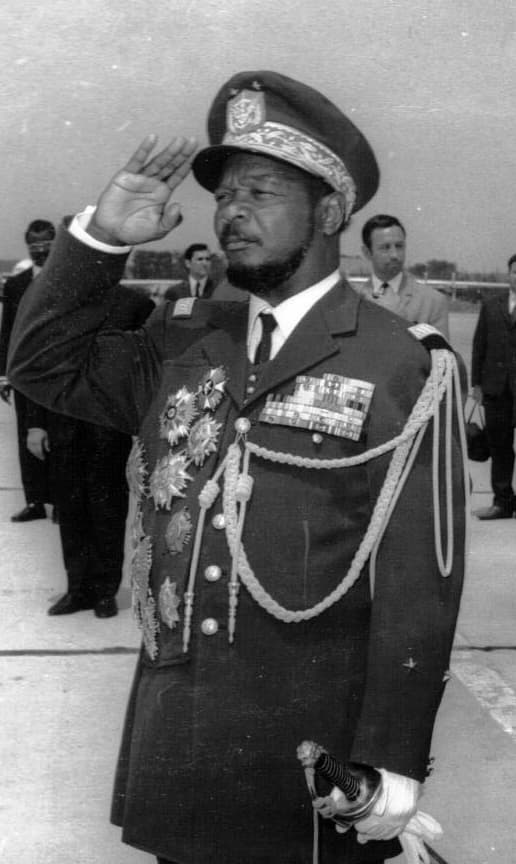
unknown, image comes from the National Archives, Attribution, via Wikimedia Commons
43/100
ACE Score: 43/100
Medium on the scale. An index, not a percentage.
60Medium
How total and coercive the leader’s power was.
43Medium
How devoted to and dependent on the leader followers became.
25Low
How hard it was to leave.
(rule-based):Pattern: walls low enough (Bubble Score under 5) for followers to leave fairly easily. A label for these scores, not a forecast. The summary and caveats describe what actually happened.
Scores are an interpretation of published sources using the ACE scoring guide, not findings of fact. Inclusion does not classify anyone as a cult. Disclaimer
Bokassa was a French army veteran who took power in a coup at the end of 1965. He made himself president for life in 1972 and crowned himself emperor in a lavish ceremony in December 1977 that cost a large share of the national budget. He personally supervised beatings and punishments, and in April 1979 around 100 schoolchildren arrested after protests over compulsory school uniforms were killed in prison. France, his main backer, then removed him in September 1979 in Operation Caban, followed by Operation Barracuda. At his 1987 trial he was convicted of murder and other crimes and sentenced to death, later commuted, but was not convicted of the cannibalism charges that made him notorious.
In academic terms, bokassa is a case of extreme personalism with weak closure: the state was small, control was erratic, and violence was episodic but directed by the ruler himself.
Where scholars disagree
The case that the framework fits
The imperial coronation and the merging of state and personal property show a ruler who demanded recognition as the embodiment of the nation.
The case that it does not fit, or overstates
Brian Titley and others stress that Bokassa's regime was shaped by French patronage and that his excesses were tolerated by Paris; his rule rested on a small army and foreign support, not on mass devotion.
The five walls
3.6 of 10
- 5
1.
Who decides what is real?
Media were state-controlled and opposition was banned. The tiny press and radio served mainly to glorify the president and later the emperor.
- 2
2.
Are friends and family outside the group cut off?
The regime did not try to reorganise families or communities. Bokassa's own many marriages were a spectacle, not a social programme.
- 3
3.
How hard is it to physically leave?
Opponents who could leave went into exile, often in France. There were no systematic exit controls on ordinary citizens.
- 1
4.
Is an apocalypse or a destined triumph always near?
Bokassa claimed the imperial crown would bring unity and dignity, modelled on Napoleon. There was no end-time framing.
- 7
5.
Does the group decide who deserves to live?
In 1972 he oversaw soldiers publicly beating convicted thieves, some of whom died. In April 1979 around 100 schoolchildren were killed in Ngaragba prison, and in August 1979 a panel of investigators chosen by African states found he was complicit.
Debt, dependence and harm
3 of 10, low
How much do followers feel they owe?
Officials and businesses depended on Bokassa's favour, and he treated state funds and diamond income as his own. Ordinary citizens were asked for little beyond obedience, though the compulsory uniforms were sold by a family-linked firm.
9 of 10, high
How far does everything rest on one person?
Bokassa held key ministries himself and reshuffled or jailed officials constantly. His rule ended only through French intervention.
+3, mostly outsiders
When the system turns violent, where does the harm go?
Total lethal violence was in the hundreds rather than thousands. Killings of protesting schoolchildren, critics and prisoners count as outward under the regime rule, while executions of his own officers and former allies, such as Alexandre Banza in 1969, count as inward; the net leans outward, and he waged no external war.
Methods of control
Specific techniques from the historical record that kept followers loyal and the bubble sealed.
- 01Personal supervision of punishments
- 02Self-coronation and imperial titles
- 03Holding multiple ministries personally
- 04Control of diamond and state revenue
- 05Arrest and killing of protesters and alleged plotters
- 06Reliance on French military and financial support
Against the reference cases
State power, violence aimed outward
Compared with Hitler
Bokassa had no ideology, mass party or wars; the comparison is mainly about the cult of the ruler.
A sealed group, violence aimed inward
Compared with Jones
Like Jones he personally punished people and made his whims law, but his subjects were not a sealed community of believers.
Through the theorists
Bokassa tried to convert military power into traditional monarchical authority through coronation, an unusual attempt to manufacture tradition.
Chehabi and Linz
His rule fits the sultanistic type: personal whim, fusion of public and private wealth, and dynastic pretensions.
Decalo
Decalo places Bokassa beside Amin and Macías Nguema as a 'personal dictator' whose psychology shaped state behaviour.
Key sources
Moderate evidence base
- Titley, Brian (1997). Dark Age: The Political Odyssey of Emperor Bokassa.
- Decalo, Samuel (1989). Psychoses of Power: African Personal Dictatorships.
Caveats
Many lurid stories, especially of cannibalism, were not proven in court, and some were spread after his fall by those who removed him. The 1979 child killings are well documented; other death tolls are uncertain. The vector is lower than for most cases here because killings were fewer and split between outsiders (students, critics) and his own officers and allies.
Cite this profile
Koziol, T. (2026). Jean-Bédel Bokassa. In ACE: Authority, Cult & Exit (Version 1.1, pilot database). Ceraluna Labs. https://cultornot.com/leader/jean-bedel-bokassa