From the ACE database. Researched and checked against published sources.
Thomas Müntzer
c. 1489 to 1525, radical Reformation preacher, active in Zwickau, Allstedt and Mühlhausen
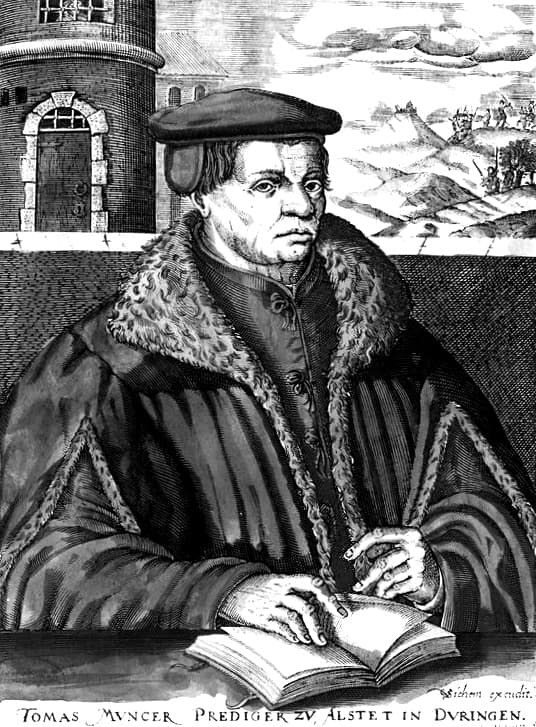
Christoph van Sichem, Public domain, via Wikimedia Commons
43/100
ACE Score: 43/100
Medium on the scale. An index, not a percentage.
50Medium
How total and coercive the leader’s power was.
63Medium
How devoted to and dependent on the leader followers became.
15Low
How hard it was to leave.
(rule-based):Pattern: walls low enough (Bubble Score under 5) for followers to leave fairly easily. A label for these scores, not a forecast. The summary and caveats describe what actually happened.
Scores are an interpretation of published sources using the ACE scoring guide, not findings of fact. Inclusion does not classify anyone as a cult. Disclaimer
Thomas Müntzer was a priest and early follower of Luther who broke with him and preached that true Christians received God's word directly through the Spirit. He believed the end times had come and that the elect must take the sword against the godless, including princes who resisted reform. In 1525 he joined the Peasants' War in Thuringia and led a peasant army at Frankenhausen, where princely forces killed thousands. He was captured, tortured and beheaded on 27 May 1525.
In academic terms, müntzer shows strong temporal and existential closure in doctrine, with little social or spatial control over followers. His movement was a loose covenant of the elect, and most of the deaths connected to him were his followers killed by the princes.
Where scholars disagree
The case that the framework fits
Müntzer claimed direct divine authority, taught that the elect were justified in killing the godless and drew followers into an imminent final struggle.
The case that it does not fit, or overstates
Scott and Goertz read him first as a Reformation theologian and mystic whose apocalyptic views were widely shared; his followers were peasants and townsmen pursuing real demands, not a closed sect. Marxist historians celebrated him as a social revolutionary, and Luther's polemics shaped his image as a fanatic.
The five walls
4 of 10
- 4
1.
Who decides what is real?
Müntzer claimed inner revelation and attacked learned scripture scholars, including Luther, as false. Followers still heard rival preachers and lived in open towns.
- 2
2.
Are friends and family outside the group cut off?
Members of his leagues stayed in their villages and families. The covenant asked for loyalty to the cause, not separation from kin.
- 1
3.
How hard is it to physically leave?
There were no compounds or restrictions on movement; the Eternal League in Mühlhausen was a voluntary association.
- 7
4.
Is an apocalypse or a destined triumph always near?
His Sermon to the Princes of 1524 read the Book of Daniel as a prophecy of the present and called for the final separation of the elect and the godless. In 1525 he urged the peasants that the time of harvest had come.
- 6
5.
Does the group decide who deserves to live?
He taught that the godless had no right to live and urged rulers to kill them, and at Frankenhausen a few prisoners from the princes' side were reportedly executed. He did not run a system of killing dissenters.
Debt, dependence and harm
4 of 10, medium
How much do followers feel they owe?
Members swore an oath to the league and were asked to risk their lives in battle. There was no surrender of property or confession system.
8 of 10, high
How far does everything rest on one person?
His leagues had little structure beyond his preaching, and the movement collapsed after Frankenhausen. Later Anabaptist groups drew on his ideas without being his organisation.
+2, mostly outsiders
When the system turns violent, where does the harm go?
His rhetoric targeted outsiders, and peasant forces in Thuringia attacked monasteries and castles. Most deaths were peasants killed by princely armies at Frankenhausen, so lethal harm by his own movement was limited.
Methods of control
Specific techniques from the historical record that kept followers loyal and the bubble sealed.
- 01Claim of direct revelation by the Spirit
- 02Covenant leagues sworn to the cause
- 03Apocalyptic reading of Daniel applied to current events
- 04Division of humanity into elect and godless
- 05Appeals to armed struggle
Against the reference cases
State power, violence aimed outward
Compared with Hitler
Both preached a final struggle against enemies, but Müntzer held no state, and most killing in his story was done to his followers.
A sealed group, violence aimed inward
Compared with Jones
Unlike Jones, Müntzer did not isolate or control followers' daily lives; his danger lay in sending them into battle.
Through the theorists
Müntzer was an emissary prophet whose authority depended on his preaching; he left no routinised organisation.
Cohn places him in a line of revolutionary millenarians who fused social grievance with apocalyptic violence.
Engels
Engels read him as an early social revolutionary using religious language for class conflict, a view later historians qualified.
Key sources
Moderate evidence base
- Scott, Tom (1989). Thomas Müntzer: Theology and Revolution in the German Reformation.
- Goertz, Hans-Jürgen (1993). Thomas Müntzer: Apocalyptic Mystic and Revolutionary.
- Cohn, Norman (1957). The Pursuit of the Millennium.
Caveats
His own writings and letters survive, but accounts of his last days come from his enemies, including a confession made under torture. East German historiography honoured him as a revolutionary hero; Lutheran tradition cast him as a fanatic. Scores reflect 1524 to 1525.
Cite this profile
Koziol, T. (2026). Thomas Müntzer. In ACE: Authority, Cult & Exit (Version 1.1, pilot database). Ceraluna Labs. https://cultornot.com/leader/thomas-muntzer