From the ACE database. Researched and checked against published sources.
António de Oliveira Salazar
1889 to 1970, finance minister from 1928 and prime minister of Portugal from 1932 until a brain haemorrhage after a fall incapacitated him in 1968
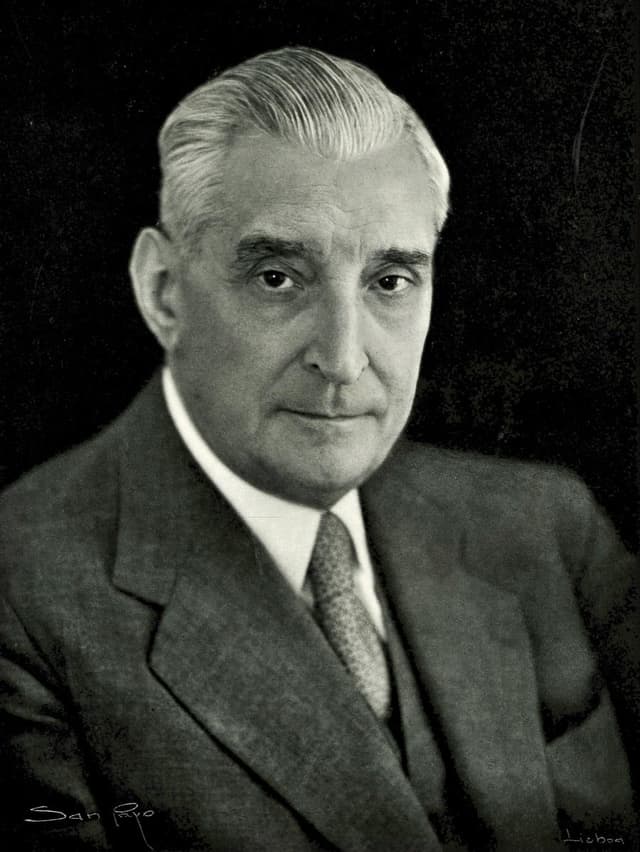
Manuel Alves de San Payo, Public domain, via Wikimedia Commons
42/100
ACE Score: 42/100
Medium on the scale. An index, not a percentage.
65Medium
How total and coercive the leader’s power was.
27Low
How devoted to and dependent on the leader followers became.
35Low
How hard it was to leave.
(rule-based):Pattern: walls low enough (Bubble Score under 5) for followers to leave fairly easily. A label for these scores, not a forecast. The summary and caveats describe what actually happened.
Scores are an interpretation of published sources using the ACE scoring guide, not findings of fact. Inclusion does not classify anyone as a cult. Disclaimer
Salazar was an economics professor who became Portugal's finance minister and then ruled as prime minister for 36 years. His Estado Novo, built on the slogan 'God, Fatherland, Family', used censorship, a political police called PIDE and a prison camp at Tarrafal in Cape Verde to silence opponents. He preferred a quiet, obedient population to mass rallies. From 1961 he fought long colonial wars in Angola, Portuguese Guinea and Mozambique. When he was incapacitated in 1968, the president replaced him with Marcelo Caetano, and the regime fell in the 1974 Carnation Revolution.
In academic terms, salazar represents moderate closure achieved through bureaucracy, Church and police rather than charisma or mass terror; high routinization and low devotion demands set him apart, while colonial war pushed the vector outward.
Where scholars disagree
The case that the framework fits
Critics point to the PIDE, Tarrafal, censorship and the colonial wars, and to Salazar's personal control over appointments, as evidence of a durable closed system.
The case that it does not fit, or overstates
António Costa Pinto and others argue the Estado Novo was a conservative authoritarian regime, not fascist or totalitarian, with no single mass party, no leader-cult on the scale of Mussolini's, and low mobilisation. Salazar distrusted charisma and crowds.
The five walls
4.4 of 10
- 6
1.
Who decides what is real?
Prior censorship, known as the 'blue pencil', applied to the press, books, theatre and film throughout his rule. Opposition was allowed only in brief, managed election campaigns.
- 3
2.
Are friends and family outside the group cut off?
The regime promoted a Catholic family model and ran youth and women's organisations, but ordinary family ties were not targeted. PIDE used informers, which bred distrust in some communities.
- 4
3.
How hard is it to physically leave?
Passports and legal emigration were restricted, so many of the roughly one million Portuguese who left for France and elsewhere in the 1960s and early 1970s went clandestinely. Political prisoners were held at Tarrafal and other jails.
- 2
4.
Is an apocalypse or a destined triumph always near?
The regime spoke of Portugal's providential, multi-continental civilising mission. There was no apocalyptic or revolutionary end-time framing.
- 7
5.
Does the group decide who deserves to live?
PIDE tortured detainees, dozens of prisoners died at Tarrafal, and opposition leader Humberto Delgado was murdered by PIDE agents in 1965. The colonial wars from 1961 killed tens of thousands of Africans, including in reprisals in northern Angola.
Debt, dependence and harm
3 of 10, low
How much do followers feel they owe?
Membership of the Portuguese Youth was compulsory for many schoolchildren, and civil servants signed declarations rejecting communism. Otherwise the regime asked for passivity rather than active participation.
3 of 10, low
How far does everything rest on one person?
The 1933 Constitution, a corporatist chamber and a strong civil service operated by rule. When Salazar was disabled in 1968, President Américo Tomás appointed Caetano and the regime continued for six more years.
+5, mostly outsiders
When the system turns violent, where does the harm go?
Under the regime rule both main targets count as outward: domestic opponents, whom the PIDE jailed, tortured and occasionally killed, and African independence movements and civilians in the colonial wars, where tens of thousands died. Inward violence against the regime's own cadres was negligible, and Portugal stayed neutral in the Second World War.
Methods of control
Specific techniques from the historical record that kept followers loyal and the bubble sealed.
- 01Prior censorship of press and culture
- 02Political police (PIDE) with informers and torture
- 03Tarrafal prison camp for political prisoners
- 04Catholic-corporatist ideology of 'God, Fatherland, Family'
- 05Restrictions on passports and emigration
- 06Managed elections with no real opposition
Against the reference cases
State power, violence aimed outward
Compared with Hitler
Salazar shared some anti-communist and corporatist ideas with fascism, but he avoided mass mobilisation, racial doctrine at home and wars of conquest in Europe.
A sealed group, violence aimed inward
Compared with Jones
Unlike Jones, Salazar made almost no personal emotional demands on followers and cultivated a remote, ascetic image.
Through the theorists
Salazar's authority was mainly legal-rational and bureaucratic, with a traditional Catholic layer; it was the least charismatic in this batch.
Linz
The Estado Novo fits Linz's authoritarian type closely: limited pluralism, demobilised citizens and a conservative mentality rather than ideology.
Clandestine emigration of around a million people shows exit used as a substitute for voice when voice was suppressed.
Key sources
Strong evidence base
- Meneses, Filipe Ribeiro de (2009). Salazar: A Political Biography.
- Gallagher, Tom (2020). Salazar: The Dictator Who Refused to Die.
Caveats
Scholars debate whether the Estado Novo was fascist; most now class it as conservative authoritarian, so 'Authoritarian ruler' is used. The colonial wars continued under Caetano until 1974, including the 1972 Wiriyamu massacre in Mozambique, but only 1961 to 1968 is counted here. Nearly all lethal violence falls on the outward side of the vector: opponents at home and Africans in the colonies.
Cite this profile
Koziol, T. (2026). António de Oliveira Salazar. In ACE: Authority, Cult & Exit (Version 1.1, pilot database). Ceraluna Labs. https://cultornot.com/leader/antonio-de-oliveira-salazar