From the ACE database. Researched and checked against published sources.
Wovoka
c. 1856 to 1932, Northern Paiute prophet of the 1890 Ghost Dance, Mason Valley, Nevada
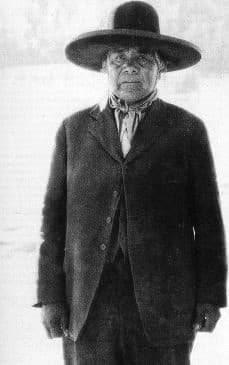
Unknown author, Public domain, via Wikimedia Commons
23/100
ACE Score: 23/100
Low on the scale. An index, not a percentage.
15Low
How total and coercive the leader’s power was.
50Medium
How devoted to and dependent on the leader followers became.
5Low
How hard it was to leave.
(rule-based):Pattern: walls low enough (Bubble Score under 5) for followers to leave fairly easily. A label for these scores, not a forecast. The summary and caveats describe what actually happened.
Scores are an interpretation of published sources using the ACE scoring guide, not findings of fact. Inclusion does not classify anyone as a cult. Disclaimer
Wovoka, also known as Jack Wilson, was a Northern Paiute man who had a vision during a solar eclipse on 1 January 1889. He taught that if Native people danced the round dance, lived honestly, worked and did not fight, the dead would return and the world would be renewed. Delegates from many nations visited him, and the Ghost Dance spread across the West. In December 1890, US Army troops killed around 250 to 300 Lakota men, women and children at Wounded Knee, partly because officials saw the dance as a threat.
In academic terms, the Ghost Dance combined strong temporal expectation with very low closure on every other dimension. The violence linked to it was committed by the US Army against Lakota people, not by the movement.
Where scholars disagree
The case that the framework fits
A prophet promised an imminent renewal and the return of the dead, and followers adopted new rituals based on his visions. Authorities at the time called it a 'messiah craze'.
The case that it does not fit, or overstates
Mooney, Hittman and Warren show the Ghost Dance as a peaceful religious response to dispossession, starvation and loss. Treating it as a cult repeats the fears that led to Wounded Knee.
The five walls
2 of 10
- 2
1.
Who decides what is real?
Wovoka's visions carried authority, but followers kept their own traditions and adapted his message, as the Lakota did with ghost shirts. There was no control of information.
- 1
2.
Are friends and family outside the group cut off?
Dancers stayed with their families and communities, and the dance was a communal event.
- 0
3.
How hard is it to physically leave?
There were no compounds or controls on movement; people came to dances and went home.
- 6
4.
Is an apocalypse or a destined triumph always near?
He promised a renewed world and the return of the dead, at times linked to a near date. This expectation inspired dancing but did not dictate daily life.
- 1
5.
Does the group decide who deserves to live?
His message told followers not to fight and to live at peace with whites. There was no dehumanisation of outsiders in his teaching.
Debt, dependence and harm
1 of 10, low
How much do followers feel they owe?
Followers gave time to the dance and sometimes paid Wovoka in gifts. There was no surrender of property.
8 of 10, high
How far does everything rest on one person?
The dance spread through delegates who returned home and led it locally. There were no offices, and Wovoka lived quietly until 1932.
0, little harm, or balanced
When the system turns violent, where does the harm go?
The movement itself caused no lethal violence. The Wounded Knee massacre of 29 December 1890 was committed by the US 7th Cavalry against Lakota people, and the earlier killing of Sitting Bull was carried out by agency police.
Methods of control
Specific techniques from the historical record that kept followers loyal and the bubble sealed.
- 01Visionary revelation
- 02Communal round dance
- 03Moral code of peace, work and honesty
- 04Delegates carrying the message to other nations
- 05Promise of renewal and return of the dead
Against the reference cases
State power, violence aimed outward
Compared with Hitler
No meaningful parallel: the Ghost Dance taught peace, and its followers were victims of state violence.
A sealed group, violence aimed inward
Compared with Jones
Unlike Jones, Wovoka did not gather or control followers; his teaching was a public ritual adapted freely by many nations.
Through the theorists
Wovoka was an ethical prophet whose message spread through other leaders, so his own charisma mattered less than the dance.
Wallace
Anthony Wallace's theory of revitalization movements fits: a vision offered a new path for a culture under extreme stress.
Mooney
Mooney compared the Ghost Dance to messianic movements in many religions, arguing it was a normal religious response to suffering.
Key sources
Strong evidence base
- Mooney, James (1896). The Ghost-Dance Religion and the Sioux Outbreak of 1890.
- Hittman, Michael (1997). Wovoka and the Ghost Dance.
- Warren, Louis S. (2017). God's Red Son: The Ghost Dance Religion and the Making of Modern America.
Caveats
Most early written records come from government officials and the army, who feared the dance. Lakota versions differed from Wovoka's own teaching. The movement's link to Wounded Knee is a matter of official fear, not of violence by dancers.
Cite this profile
Koziol, T. (2026). Wovoka. In ACE: Authority, Cult & Exit (Version 1.1, pilot database). Ceraluna Labs. https://cultornot.com/leader/wovoka