From the ACE database. Researched and checked against published sources.
Hugo Chávez
1954 to 2013, led a failed coup in 1992, elected president in 1998 and re-elected in 2000, 2006 and 2012
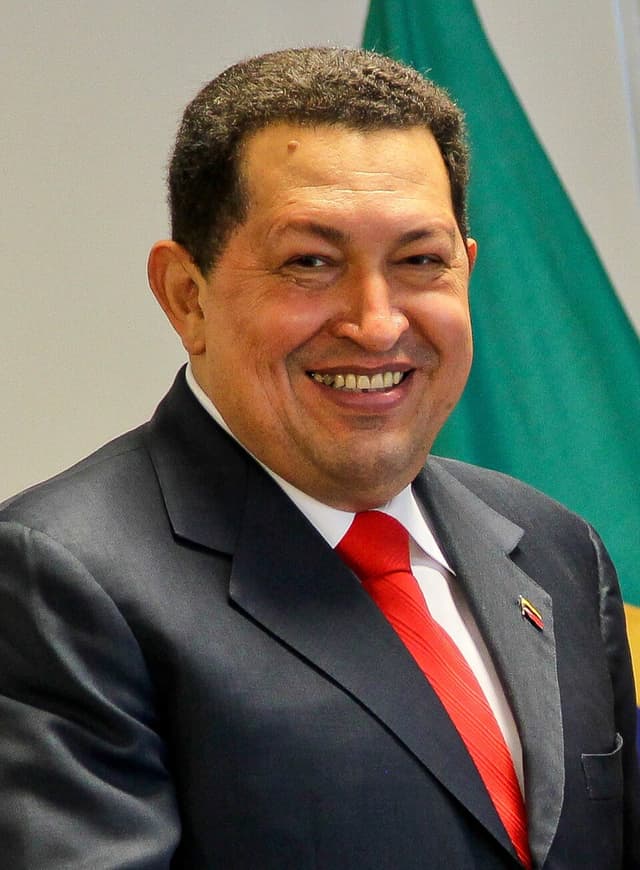
Roberto Stuckert Filho, CC BY-SA 2.0, via Wikimedia Commons
30/100
ACE Score: 30/100
Low on the scale. An index, not a percentage.
35Low
How total and coercive the leader’s power was.
40Medium
How devoted to and dependent on the leader followers became.
15Low
How hard it was to leave.
(rule-based):Pattern: walls low enough (Bubble Score under 5) for followers to leave fairly easily. A label for these scores, not a forecast. The summary and caveats describe what actually happened.
Scores are an interpretation of published sources using the ACE scoring guide, not findings of fact. Inclusion does not classify anyone as a cult. Disclaimer
Hugo Chávez was a Venezuelan army officer who led a failed coup in 1992 and then won the presidency by election in 1998. He rewrote the constitution in 1999, used oil revenue for social programmes called missions, and spoke to the nation for hours on his TV show Aló Presidente. He survived a brief coup against him in 2002 and won a recall referendum in 2004. Over time he expanded the Supreme Court, refused to renew the broadcast licence of the opposition channel RCTV and removed presidential term limits, while still holding regular elections, one of which he lost in 2007.
In academic terms, chávez raised epistemic and debt closure through media pressure and patronage, but elections, an active opposition and open borders kept overall closure moderate; his system depended heavily on him personally.
Where scholars disagree
The case that the framework fits
Corrales and Penfold and Human Rights Watch document court-packing, media closures, political discrimination and steady erosion of checks, which fits the pattern of competitive authoritarianism under elected rule.
The case that it does not fit, or overstates
Supporters and some scholars stress repeated elections that international observers judged broadly valid, a lost 2007 referendum he accepted, broad support among the poor, and an opposition that kept media, parties and governorships.
The five walls
2.6 of 10
- 4
1.
Who decides what is real?
His government refused to renew RCTV's licence in 2007 and passed media laws that encouraged self-censorship, and his mandatory broadcasts were frequent. Opposition newspapers and channels such as Globovisión still operated through most of his rule.
- 2
2.
Are friends and family outside the group cut off?
Politics polarised families and workplaces. There was no state effort to break family ties.
- 1
3.
How hard is it to physically leave?
Venezuelans could travel and emigrate freely, though currency controls from 2003 made foreign travel harder.
- 3
4.
Is an apocalypse or a destined triumph always near?
He framed his rule as a 'Bolivarian revolution' building 'socialism of the 21st century' with the slogan 'patria, socialismo o muerte'. This was a historical mission without a dated end.
- 3
5.
Does the group decide who deserves to live?
Chávez called opponents 'escuálidos', oligarchs and traitors. Judge María Lourdes Afiuni was jailed in 2009 after he publicly demanded a long sentence for her.
Debt, dependence and harm
3 of 10, low
How much do followers feel they owe?
The Tascón list of recall-petition signers was used to deny some people state jobs and services, and public employees faced pressure to attend rallies. Many poor households depended on the missions.
6 of 10, medium
How far does everything rest on one person?
He founded the PSUV in 2007 and named Nicolás Maduro his successor before dying in 2013. Courts, the electoral council and the military were bent toward his personal leadership.
0, little harm, or balanced
When the system turns violent, where does the harm go?
Political violence occurred, including deaths on both sides during the April 2002 crisis, but there was no campaign of killing against outsiders or members.
Methods of control
Specific techniques from the historical record that kept followers loyal and the bubble sealed.
- 01Long televised addresses and mandatory broadcasts
- 02Constitutional rewrite by referendum
- 03Court expansion and loyal appointments
- 04Oil-funded missions creating dependence
- 05Lists of opponents used for discrimination
- 06Rhetoric of the people against oligarchs
Against the reference cases
State power, violence aimed outward
Compared with Hitler
Chávez used plebiscites and enemy rhetoric but kept elections, allowed opposition parties and committed no mass violence; the gap is very large.
A sealed group, violence aimed inward
Compared with Jones
Like Jones he spoke as a redeemer of the poor, but citizens kept their homes, families and freedom to leave.
Through the theorists
Charismatic authority that drew on election rather than replacing it, with weak routinisation.
Levitsky and Way
A model case of competitive authoritarianism, where elections are real but the playing field is tilted.
Laclau
Populism as building a 'people' against an elite, which some read as democratic renewal.
Key sources
Strong evidence base
- Corrales, Javier, and Michael Penfold (2011). Dragon in the Tropics: Hugo Chávez and the Political Economy of Revolution in Venezuela.
- Carroll, Rory (2013). Comandante: Hugo Chávez's Venezuela.
- Human Rights Watch (2008). A Decade Under Chávez: Political Intolerance and Lost Opportunities for Advancing Human Rights in Venezuela.
Caveats
Assessments are highly polarised. Closure rose over time, from low in 1999 to moderate by 2009 to 2012. The deeper repression after 2013 belongs to Maduro and is not scored here.
Cite this profile
Koziol, T. (2026). Hugo Chávez. In ACE: Authority, Cult & Exit (Version 1.1, pilot database). Ceraluna Labs. https://cultornot.com/leader/hugo-chavez