From the ACE database. Researched and checked against published sources.
Maximilien Robespierre
1758 to 1794, Jacobin leader and the most prominent member of the Committee of Public Safety during the Terror
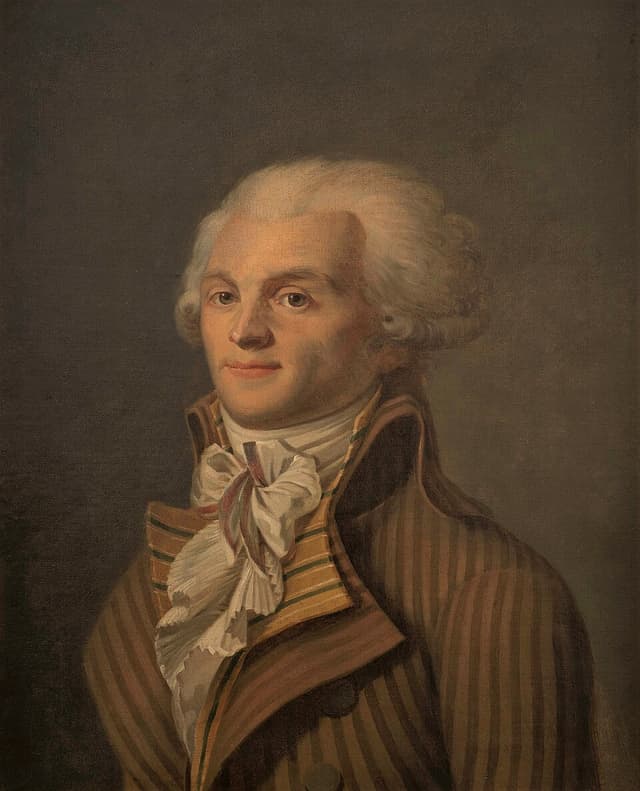
Unidentified painter, CC0, via Wikimedia Commons
60/100
ACE Score: 60/100
Medium on the scale. An index, not a percentage.
75High
How total and coercive the leader’s power was.
60Medium
How devoted to and dependent on the leader followers became.
45Medium
How hard it was to leave.
(rule-based):Pattern: a closed system with little institutional restraint, where harm was aimed mainly at outsiders. A label for these scores, not a forecast. The summary and caveats describe what actually happened.
Scores are an interpretation of published sources using the ACE scoring guide, not findings of fact. Inclusion does not classify anyone as a cult. Disclaimer
Maximilien Robespierre was a lawyer who became the best-known leader of the radical Jacobins in the French Revolution. From July 1793 he sat on the Committee of Public Safety, which ran France during war and civil war. In this period, known as the Terror, revolutionary courts across France handed down about 16,600 official death sentences, and many more people died in prison, were killed without trial, or died in the crushing of revolts. Robespierre spoke of a Republic of Virtue and staged a Festival of the Supreme Being. In July 1794 the National Convention turned on him, and he was guillotined.
In academic terms, robespierre represents high temporal and existential closure driven by a vision of moral regeneration, but low leader dependence: the Terror was run by committees, and the Convention removed him in a day.
Where scholars disagree
The case that the framework fits
Ruth Scurr and J. L. Talmon's tradition see in Robespierre a pure moralist whose vision of virtue made terror a duty, an early case of political messianism.
The case that it does not fit, or overstates
Peter McPhee and R. R. Palmer stress that the Terror was a collective response to war and civil war, that Robespierre was often ill and absent, and that he was blamed afterwards by the men who overthrew him. He also defended universal male suffrage and opposed slavery.
The five walls
6.2 of 10
- 7
1.
Who decides what is real?
The Law of Suspects (September 1793) allowed arrest for opinions and associations, and journalists such as Camille Desmoulins were executed. Robespierre defined virtue and treated opposition as a sign of corruption or treason.
- 4
2.
Are friends and family outside the group cut off?
Denunciation of neighbours was encouraged through local revolutionary committees, and relatives of émigrés were treated as suspects. Family life was otherwise not reorganised.
- 5
3.
How hard is it to physically leave?
Emigrés were banished and faced death if they returned, and internal movement required certificates of civic loyalty. Suspects were held in crowded prisons awaiting trial.
- 7
4.
Is an apocalypse or a destined triumph always near?
The new Republican calendar restarted time at Year I, and revolutionaries spoke of regenerating humanity. Robespierre framed the struggle as a final battle between virtue and vice during foreign war.
- 8
5.
Does the group decide who deserves to live?
Donald Greer counted about 16,600 official death sentences from March 1793 to August 1794, and perhaps 10,000 or more people died in prison or were killed without trial, with many more dying in the repression of revolts in the Vendée and Lyon. The Law of 22 Prairial (June 1794), which Robespierre backed, removed defence counsel and sped up executions.
Debt, dependence and harm
6 of 10, medium
How much do followers feel they owe?
Citizens were expected to show civic virtue through oaths, attendance at section meetings and certificates of patriotism. Mass conscription in 1793 demanded the whole nation's service.
5 of 10, medium
How far does everything rest on one person?
Robespierre was one of twelve committee members and never held sole power. The Convention voted to arrest him on 9 Thermidor (27 July 1794) and the Republic continued without him.
+6, mostly outsiders
When the system turns violent, where does the harm go?
Outward: most victims were people defined as enemies of the Revolution, namely rebels, suspected counter-revolutionaries, nobles and priests; Greer found most were peasants and workers from rebel regions. Inward: Robespierre also helped send fellow revolutionaries, including the Girondin deputies, Hébert and Danton, to the guillotine, but these numbered in the dozens.
Methods of control
Specific techniques from the historical record that kept followers loyal and the bubble sealed.
- 01Law of Suspects allowing arrest for opinions
- 02Revolutionary Tribunal with fast trials and the guillotine
- 03Jacobin clubs and local committees encouraging denunciation
- 04Civic certificates and oaths of loyalty
- 05A new calendar and the Cult of the Supreme Being
- 06Purging rival factions as traitors
Against the reference cases
State power, violence aimed outward
Compared with Hitler
Both justified killing as purifying the nation, but Robespierre had no racial ideology and held power only within a committee for one year.
A sealed group, violence aimed inward
Compared with Jones
Robespierre's call for virtue resembles a moral crusade, but he was removed by an assembly and never controlled followers' daily lives as Jones did.
Through the theorists
Robespierre's charisma rested on his reputation as 'the Incorruptible', but authority stayed with the Convention and its committees.
J. L. Talmon
Talmon placed Robespierre at the origin of 'totalitarian democracy', where one true general will justifies coercing dissenters.
Hannah Arendt
In On Revolution, Arendt argued that the politics of virtue and compassion led the French Revolution into terror against hidden enemies.
Key sources
Strong evidence base
- McPhee, Peter (2012). Robespierre: A Revolutionary Life.
- Scurr, Ruth (2006). Fatal Purity: Robespierre and the French Revolution.
- Palmer, R. R. (1941). Twelve Who Ruled: The Committee of Public Safety during the Terror.
Caveats
Robespierre's personal role is one of the most disputed questions in French history; Thermidorian accounts blamed him for everything. The execution figure comes from Donald Greer's 1935 statistical study; Vendée death estimates vary widely and are linked more to other officials and generals. Scores cover only July 1793 to July 1794. Under the regime rule, rebels and suspects count as outward and purged revolutionaries as inward; the net is clearly outward.
Cite this profile
Koziol, T. (2026). Maximilien Robespierre. In ACE: Authority, Cult & Exit (Version 1.1, pilot database). Ceraluna Labs. https://cultornot.com/leader/maximilien-robespierre