From the ACE database. Researched and checked against published sources.
Ho Chi Minh
1890 to 1969, founder of the Indochinese Communist Party and president of the Democratic Republic of Vietnam (North Vietnam)
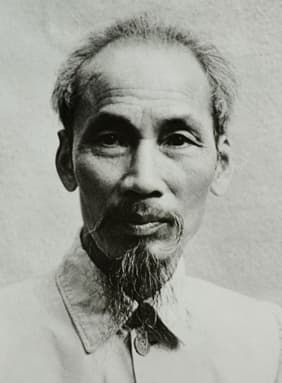
Unknown author, Public domain, via Wikimedia Commons
60/100
ACE Score: 60/100
Medium on the scale. An index, not a percentage.
70High
How total and coercive the leader’s power was.
50Medium
How devoted to and dependent on the leader followers became.
60Medium
How hard it was to leave.
(rule-based):Pattern: a closed system with strong offices, rules and succession. A label for these scores, not a forecast. The summary and caveats describe what actually happened.
Scores are an interpretation of published sources using the ACE scoring guide, not findings of fact. Inclusion does not classify anyone as a cult. Disclaimer
Ho Chi Minh spent about two decades abroad, much of it as a Comintern agent, before declaring Vietnam's independence in 1945. As president of the Democratic Republic of Vietnam he led the war against French colonial rule, and after 1954 he headed communist North Vietnam. His government's land reform of 1953 to 1956 used quotas and public denunciation sessions, and thousands of people labelled landlords were executed. From around 1960 real power shifted toward Le Duan and the party leadership, while Ho remained the beloved symbol of the nation, called 'Uncle Ho'.
In academic terms, ho embodied a national-liberation cult inside a disciplined party, so closure and existential violence were high in the land reform period while dependence on his person was low.
Where scholars disagree
The case that the framework fits
Ho's image was turned into a cult, his body was embalmed and displayed, and the land reform under his presidency used quotas, denunciation and execution.
The case that it does not fit, or overstates
Biographers such as William Duiker stress Ho's nationalism, modest style and wide popularity, and Sophie Quinn-Judge shows he often lacked control over party policy. Many Vietnamese see him as a liberator from colonial rule rather than a dictator.
The five walls
6.4 of 10
- 7
1.
Who decides what is real?
The party controlled all publications, and the 1956 to 1958 Nhan Van Giai Pham movement of writers seeking freedom was suppressed. Doctrine and Ho's sayings were taught as guides to correct thinking.
- 6
2.
Are friends and family outside the group cut off?
During land reform, villagers including relatives were pressed to denounce accused landlords at public tribunals. Party cells reached into villages and families, and class labels shaped marriage and schooling.
- 6
3.
How hard is it to physically leave?
After the 1954 Geneva Accords, about 800,000 to one million northerners moved south during the open period before the border closed. Afterwards movement was controlled by household registration and travel permits.
- 6
4.
Is an apocalypse or a destined triumph always near?
Life was organised around a struggle for national reunification and socialism framed as historical destiny. Ho's motto 'Nothing is more precious than independence and freedom' was used to justify total war.
- 7
5.
Does the group decide who deserves to live?
Edwin Moise, revising his earlier range of 3,000 to 15,000, estimates about 13,500 executions during land reform; Hungarian diplomatic records studied by Balázs Szalontai give a minimum of about 1,300, and a party archive document cited by Vo Nhan Tri gives 15,000. The party admitted 'serious mistakes' and launched a Rectification of Errors in 1956.
Debt, dependence and harm
6 of 10, medium
How much do followers feel they owe?
Cadres practised criticism and self-criticism sessions, and peasants were pushed into cooperatives. Young people were mobilised for long war service in the South.
3 of 10, low
How far does everything rest on one person?
The Workers' Party ruled through a Politburo and Central Committee, and Ho was not the sole decision-maker after the late 1950s. After his death in 1969 collective leadership continued without crisis.
+4, mostly outsiders
When the system turns violent, where does the harm go?
Outward: land reform violence targeted people classified as landlords and class enemies, and the 1956 Catholic peasant revolt at Quynh Luu was put down by the army. Inward: many of those executed were party members and loyal peasants wrongly labelled, as the 1956 Rectification of Errors admitted. The wars against French and US-backed forces are treated by most historians as anti-colonial and civil war rather than aggression.
Methods of control
Specific techniques from the historical record that kept followers loyal and the bubble sealed.
- 01Land reform tribunals with class quotas and public denunciation
- 02Criticism and self-criticism sessions for cadres
- 03Household registration and travel permits
- 04Party control of writers and intellectuals
- 05Paternal 'Uncle Ho' imagery binding the nation to a family figure
- 06Mass mobilisation for a long war of reunification
Against the reference cases
State power, violence aimed outward
Compared with Hitler
Both were objects of a strong cult and headed regimes that killed defined enemies, but Ho led an anti-colonial struggle and did not pursue genocide or territorial conquest of other nations.
A sealed group, violence aimed inward
Compared with Jones
Ho's party was a large institution that did not depend on him, while Jones's group could not survive him.
Through the theorists
Ho's charisma was absorbed into party institutions early, so his authority after the 1950s was largely symbolic.
Robert Jay Lifton
Land reform tribunals and self-criticism used confession and milieu control similar to Chinese 'thought reform', which Lifton analysed.
Hannah Arendt
The combination of party ideology, class enemies and campaign terror in 1953 to 1956 has totalitarian features, but the regime was also a national war state.
Key sources
Moderate evidence base
- Duiker, William J. (2000). Ho Chi Minh.
- Quinn-Judge, Sophie (2002). Ho Chi Minh: The Missing Years, 1919–1941.
- Moise, Edwin E. (1983). Land Reform in China and North Vietnam: Consolidating the Revolution at the Village Level.
Caveats
Archives are still restricted, and the land reform death toll is debated, from about 1,300 to 15,000 executions; older claims of 50,000 or more are now generally seen as exaggerated. Ho's personal responsibility for land reform is contested because Chinese advisers and party leaders such as Truong Chinh shaped it. Scores reflect the 1950s peak, not the 1945 to 1946 period. Under the regime rule, killings of people labelled class enemies count as outward and killings of party members count as inward; the net is moderately outward.
Cite this profile
Koziol, T. (2026). Ho Chi Minh. In ACE: Authority, Cult & Exit (Version 1.1, pilot database). Ceraluna Labs. https://cultornot.com/leader/ho-chi-minh