From the ACE database. Researched and checked against published sources.
Sergey Nechayev
1847 to 1882, organised a secret revolutionary society in Moscow in 1869, fled to Switzerland, was extradited in 1872 and died in the Peter and Paul Fortress
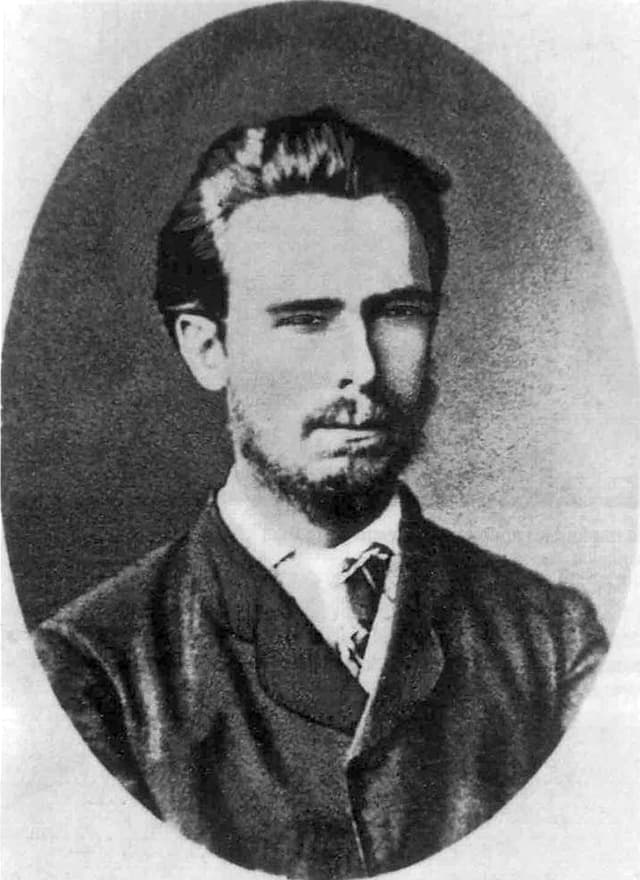
Unknown, but it is safe to assume he/she was dead by 1940 (ie, 70 ye…, Public domain, via Wikimedia Commons
66/100
ACE Score: 66/100
Medium on the scale. An index, not a percentage.
65Medium
How total and coercive the leader’s power was.
77High
How devoted to and dependent on the leader followers became.
55Medium
How hard it was to leave.
(rule-based):Pattern: a closed system with little institutional restraint, where harm was aimed mainly at its own people. A label for these scores, not a forecast. The summary and caveats describe what actually happened.
Scores are an interpretation of published sources using the ACE scoring guide, not findings of fact. Inclusion does not classify anyone as a cult. Disclaimer
Sergey Nechayev was a young Russian revolutionary who in 1869 won the trust of the anarchist Mikhail Bakunin by claiming to represent a large revolutionary organisation that did not exist. He wrote, possibly with Bakunin's input, the 'Catechism of a Revolutionary', which said a revolutionary must break all ties with society and accept any means. Back in Moscow he formed a secret society called People's Retribution. In November 1869 he and others murdered a member, Ivan Ivanov, who had questioned him. Nechayev fled abroad, was arrested in Zurich and extradited in 1872, sentenced in 1873 to 20 years' hard labour and died in prison in 1882. Dostoevsky based his novel 'Demons' on the case.
In academic terms, nechayev built control mainly from deception and complicity rather than a compound or mass following: a fictional hierarchy closed members' knowledge, and a murder bound them together. His 'Catechism' is an early written blueprint for total devotion debt.
Where scholars disagree
The case that the framework fits
Pomper and Avrich describe systematic lying, blackmail of allies, a fictitious hierarchy and the murder of a dissenting member, which match core methods of coercive control.
The case that it does not fit, or overstates
Nechayev led a tiny circle for a few months, and some historians see him as an extreme case within a wider Russian revolutionary culture rather than a cult leader. The authorship of the 'Catechism' and Bakunin's share in it remain disputed.
The five walls
6.2 of 10
- 6
1.
Who decides what is real?
Nechayev told members they took orders from a secret central committee that existed only in his claims. He lied to Bakunin and to recruits about the size of the movement.
- 7
2.
Are friends and family outside the group cut off?
The 'Catechism' states that the revolutionary has no personal interests, ties, feelings or property and must break with family, friendship and love. Nechayev took compromising papers from allies and, in his society's name, threatened the publisher's agent Lyubavin to free Bakunin from a translation contract.
- 4
3.
How hard is it to physically leave?
Members lived in Moscow and moved freely, with no compound. The murder of Ivanov showed that defying the leader could be fatal.
- 7
4.
Is an apocalypse or a destined triumph always near?
Nechayev predicted a popular uprising in February 1870, the date when peasant obligations from the 1861 emancipation ended. He framed the struggle as an imminent, total destruction of the old order.
- 7
5.
Does the group decide who deserves to live?
The 'Catechism' calls for the 'merciless destruction' of society and lists categories of people to be killed. Ivanov was beaten, strangled and shot in November 1869.
Debt, dependence and harm
7 of 10, high
How much do followers feel they owe?
The 'Catechism' describes the revolutionary as a 'doomed man' who gives everything to the cause. Nechayev made members complicit in Ivanov's murder, which bound them to him through shared guilt.
9 of 10, high
How far does everything rest on one person?
People's Retribution was a few small circles with no structure beyond Nechayev. It collapsed after the murder and the arrest of its members.
-4, mostly insiders
When the system turns violent, where does the harm go?
The only documented killing was of a group member, Ivanov. Nechayev's violent doctrine aimed at outsiders was never carried out by his circle.
Methods of control
Specific techniques from the historical record that kept followers loyal and the bubble sealed.
- 01A fictional central committee issuing orders
- 02Written code demanding the break of all personal ties
- 03Blackmail with stolen letters
- 04Binding members through shared complicity in murder
- 05False predictions of an imminent uprising
- 06Five-member cells with limited knowledge of each other
Against the reference cases
State power, violence aimed outward
Compared with Hitler
Nechayev wrote a doctrine of total destruction that later revolutionaries cited, but he commanded a handful of students and killed one of them.
A sealed group, violence aimed inward
Compared with Jones
Like Jones, he turned violence on his own follower to secure loyalty, but on a far smaller scale and without a community.
Through the theorists
Charismatic authority that relied on a fake bureaucracy: the invented central committee lent his orders an impersonal authority he did not have.
An early example of the secret society logic she saw in totalitarian movements, where lies and complicity bind members tighter than belief.
Pomper
Pomper reads Nechayev's personality and the radical student milieu together, showing how a willing audience gave his deception power.
Key sources
Moderate evidence base
- Pomper, Philip (1979). Sergei Nechaev.
- Avrich, Paul (1988). Anarchist Portraits.
Caveats
Many sources are trial records and accounts by people he deceived, and the 'Catechism' text's authorship is contested. The five-member cell structure is reported in secondary literature but details vary. Scores describe 1869, his period of active leadership.
Cite this profile
Koziol, T. (2026). Sergey Nechayev. In ACE: Authority, Cult & Exit (Version 1.1, pilot database). Ceraluna Labs. https://cultornot.com/leader/sergey-nechayev