From the ACE database. Researched and checked against published sources.
Rafael Trujillo
1891 to 1961, army commander who took power in 1930 and ruled the Dominican Republic directly or through puppet presidents until his assassination in May 1961
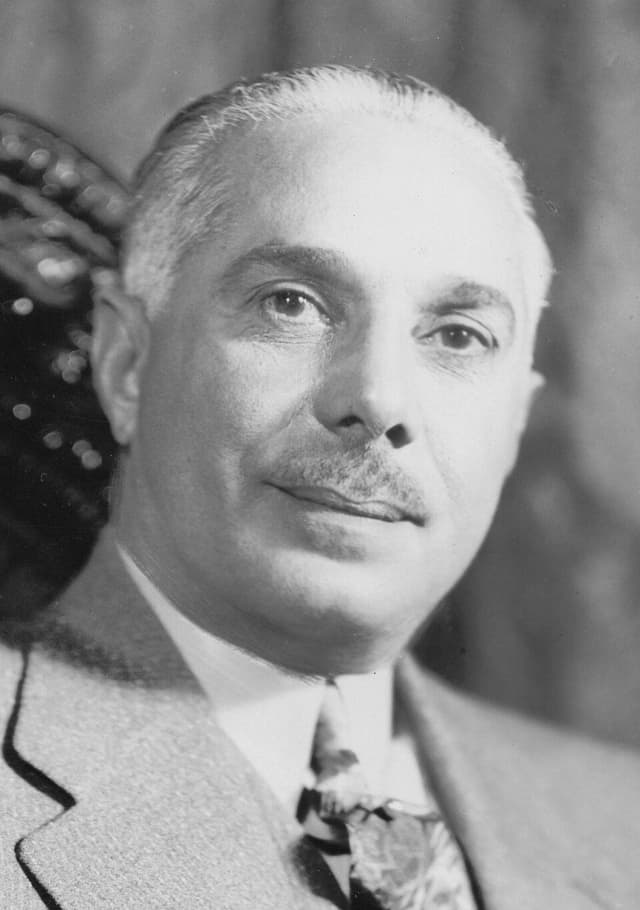
Unknown author., Public domain, via Wikimedia Commons
67/100
ACE Score: 67/100
Medium on the scale. An index, not a percentage.
85High
How total and coercive the leader’s power was.
60Medium
How devoted to and dependent on the leader followers became.
55Medium
How hard it was to leave.
(rule-based):Pattern: a closed system with little institutional restraint, where harm was aimed mainly at outsiders. A label for these scores, not a forecast. The summary and caveats describe what actually happened.
Scores are an interpretation of published sources using the ACE scoring guide, not findings of fact. Inclusion does not classify anyone as a cult. Disclaimer
Trujillo was commander of the army, which grew out of the US-trained National Guard, when he seized power in 1930 and ruled for 31 years. He renamed the capital Ciudad Trujillo, put his name on mountains, provinces and streets, and signs reading 'God and Trujillo' appeared in homes. His family controlled a large share of the economy. In October 1937 his army massacred an estimated 12,000 to 30,000 Haitians and Dominicans of Haitian descent in the border region. His secret police killed opponents at home and abroad, including the Mirabal sisters in 1960. He was assassinated in 1961.
In academic terms, trujillo combined near-total epistemic and economic closure with a racialised mass killing, making him one of the most complete personal dictatorships in the Americas; the system did not survive his death.
Where scholars disagree
The case that the framework fits
The naming of the capital and landmarks after him, the household slogans and the economic monopoly show a cult backed by terror and material dependence.
The case that it does not fit, or overstates
Richard Lee Turits shows that many peasants gained land and security under Trujillo and remembered him with some approval, and Lauren Derby argues his power worked through seduction and popular imagination as well as fear.
The five walls
6.2 of 10
- 8
1.
Who decides what is real?
All press and radio praised Trujillo, and newspapers ran denunciations of people who fell from favour. Signs such as 'God and Trujillo' and 'In this house Trujillo is chief' were displayed in homes.
- 5
2.
Are friends and family outside the group cut off?
The secret police (SIM) used informers in workplaces and neighbourhoods, and attendance at rallies was compulsory. Trujillo and his circle took women from families who could not refuse.
- 6
3.
How hard is it to physically leave?
Travel abroad required permission, and exiles were watched and sometimes killed. Spanish Republican exile Jesús de Galíndez was kidnapped in New York in 1956 and disappeared.
- 3
4.
Is an apocalypse or a destined triumph always near?
Regime propaganda presented the 'Era of Trujillo' as the rebirth of a Hispanic, Catholic nation. There was no apocalyptic timetable.
- 9
5.
Does the group decide who deserves to live?
In the 1937 Parsley Massacre the army killed thousands of Haitians and Dominicans of Haitian descent, with most estimates between about 12,000 and 30,000. Political opponents were routinely murdered, including the three Mirabal sisters in November 1960.
Debt, dependence and harm
7 of 10, high
How much do followers feel they owe?
The Dominican Party membership card, the 'palmita', was needed for jobs and daily dealings, and state employees had part of their salaries deducted for the party. Trujillo's family owned much of the economy, so livelihoods depended on his favour.
8 of 10, high
How far does everything rest on one person?
Puppet presidents held office while Trujillo kept real power, and ministers were rotated and humiliated. The regime fell apart within months of his assassination.
+8, mostly outsiders
When the system turns violent, where does the harm go?
The 1937 massacre was ethnic killing of a population defined as foreign, and the murders of opponents at home and exiles abroad count as outward under the regime rule. The regime also tried to assassinate Venezuelan President Rómulo Betancourt in 1960; killings of fallen insiders were few by comparison.
Methods of control
Specific techniques from the historical record that kept followers loyal and the bubble sealed.
- 01Secret police (SIM) and informer networks
- 02Compulsory party membership card and salary deductions
- 03Ubiquitous leader-cult in place names and slogans
- 04Family control of the economy
- 05Assassination of exiles abroad
- 06Racialised anti-Haitian nationalism
Against the reference cases
State power, violence aimed outward
Compared with Hitler
Trujillo's racial nationalism and the 1937 massacre echo Nazi doctrine on a smaller scale, but he built no ideological mass movement.
A sealed group, violence aimed inward
Compared with Jones
Like Jones, he demanded constant displays of devotion and controlled people's livelihoods, but on a national rather than communal scale.
Through the theorists
Trujillo's rule was patrimonial: the country functioned as his estate, with offices given and withdrawn as personal favours.
Chehabi and Linz
The Dominican Republic under Trujillo is a textbook case of sultanism.
Derby
Derby argues that the regime bound people through gift, spectacle and sexual politics, not only coercion.
Key sources
Strong evidence base
- Crassweller, Robert D. (1966). Trujillo: The Life and Times of a Caribbean Dictator.
- Turits, Richard Lee (2003). Foundations of Despotism: Peasants, the Trujillo Regime, and Modernity in Dominican History.
- Derby, Lauren (2009). The Dictator's Seduction: Politics and the Popular Imagination in the Era of Trujillo.
Caveats
Estimates of the 1937 death toll vary widely, from about 12,000 to well over 20,000. Almost all lethal violence falls on the outward side of the vector. He is classed as an authoritarian ruler because the regime is a classic sultanistic case rather than a party-led totalitarian state. Peasant memory of the regime is more mixed than elite and exile accounts, as Turits shows.
Cite this profile
Koziol, T. (2026). Rafael Trujillo. In ACE: Authority, Cult & Exit (Version 1.1, pilot database). Ceraluna Labs. https://cultornot.com/leader/rafael-trujillo