From the ACE database. Researched and checked against published sources.
Joseph Stalin
1878 to 1953, General Secretary of the Communist Party from 1922 and unchallenged ruler of the Soviet Union from the late 1920s until his death in March 1953
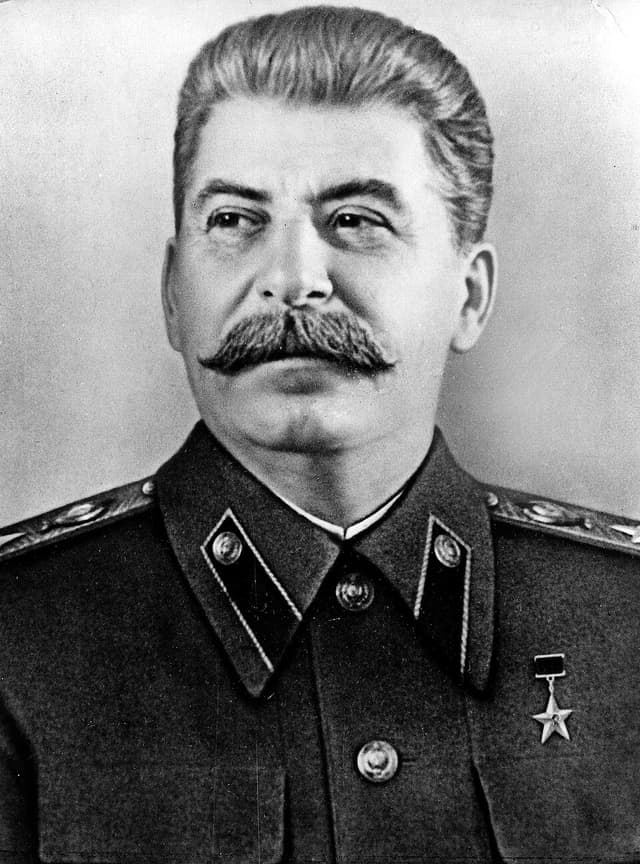
Ivan Shagin, Public domain, via Wikimedia Commons
83/100
ACE Score: 83/100
High on the scale. An index, not a percentage.
100High
How total and coercive the leader’s power was.
63Medium
How devoted to and dependent on the leader followers became.
85High
How hard it was to leave.
(rule-based):Pattern: a closed system with little institutional restraint, where harm was aimed mainly at its own people. A label for these scores, not a forecast. The summary and caveats describe what actually happened.
Scores are an interpretation of published sources using the ACE scoring guide, not findings of fact. Inclusion does not classify anyone as a cult. Disclaimer
Stalin rose through the Communist Party after Lenin's death and by about 1929 had defeated his rivals. He forced peasants into collective farms, drove rapid industrialisation, and built the Gulag labour camp system, where about 1.5 to 1.7 million people died. The famine of 1930 to 1933 killed roughly 5.7 to 8.7 million people. In the Great Terror of 1937 and 1938 the secret police shot about 680,000 people, mostly peasants, former 'kulaks' and members of national minorities, along with many party, army and state officials. Whole ethnic groups were also deported.
In academic terms, stalin combined near-total epistemic and spatial closure with a vector that cut both ways: deliberate killing was aimed mostly at defined enemies and invaded neighbours, but the larger famine death toll fell on the peasantry the regime claimed as its own.
Where scholars disagree
The case that the framework fits
Kotkin and Khlevniuk, using opened archives, show Stalin personally directed the Terror and signed execution lists. The leader cult, ritual confessions and denunciation look much like high-control group dynamics at national scale.
The case that it does not fit, or overstates
Social historians such as Sheila Fitzpatrick and J. Arch Getty stressed pressures from below and local initiative in the purges. Many citizens supported the regime for practical or patriotic reasons rather than out of devotion to Stalin.
The five walls
8.6 of 10
- 10
1.
Who decides what is real?
All media, publishing and education were controlled by the party, and history was rewritten to fit the current line. Careless remarks or jokes could bring arrest under Article 58 of the criminal code for 'counter-revolutionary' activity.
- 8
2.
Are friends and family outside the group cut off?
The boy Pavlik Morozov, said to have denounced his father, was held up as a hero. NKVD Order 00486 of 1937 sent wives of convicted 'traitors' to camps and placed their children in state orphanages.
- 9
3.
How hard is it to physically leave?
Internal passports introduced in December 1932 tied people to their place of residence, and collective farmers were long denied them. Foreign travel was almost impossible, borders were guarded, and the Gulag held millions.
- 6
4.
Is an apocalypse or a destined triumph always near?
Doctrine presented communism as the destined end of history and the Soviet Union as besieged by capitalist enemies. Stalin's claim that class struggle sharpens as socialism advances justified constant vigilance rather than a dated end.
- 10
5.
Does the group decide who deserves to live?
'Enemies of the people', kulaks and suspect nationalities were dehumanised in doctrine and killed or deported in large numbers. NKVD records show about 680,000 executions in 1937 and 1938 alone.
Debt, dependence and harm
8 of 10, high
How much do followers feel they owe?
Every job, flat and ration card came from the state, and survival required public praise of Stalin. Citizens and cadres were pressed to denounce colleagues, confess at party meetings and sign off on purges.
5 of 10, medium
How far does everything rest on one person?
The party, ministries and secret police were large, rule-bound bureaucracies, but Stalin could purge any of their leaders at will. He left no succession mechanism, and his heirs struggled for power after 1953.
-2, mostly insiders
When the system turns violent, where does the harm go?
Outward: most of the 680,000 people shot in 1937 and 1938 died in operations against 'kulaks', 'anti-Soviet elements' and national minorities, and there were deaths among deported kulaks and peoples, the Katyn massacre of about 22,000 Poles, and invasions of Poland, Finland and the Baltic states. Inward: the famines of 1930 to 1933 (about 5.7 to 8.7 million dead) and 1946 to 1947 (roughly 1 to 1.5 million) fell mainly on collective-farm peasants, and the purges struck the party, army and state apparatus.
Methods of control
Specific techniques from the historical record that kept followers loyal and the bubble sealed.
- 01Leader cult in art, schools and the press
- 02Secret police terror and show trials
- 03Gulag labour camps
- 04Internal passports and closed borders
- 05Denunciation and public confession
- 06State monopoly on jobs, housing and food
- 07Collective punishment of families
Against the reference cases
State power, violence aimed outward
Compared with Hitler
Both built total information control and a leader cult, but far more of the deaths under Stalin fell on the peasants and party members his regime claimed as its own, while Hitler's violence was aimed chiefly at racial outsiders and foreign nations.
A sealed group, violence aimed inward
Compared with Jones
Like Jones, Stalin used staged confessions and loyalty tests, but he governed a superpower and his violence was bureaucratic rather than a single act of collective death.
Through the theorists
Stalin's rule shows charisma manufactured by a bureaucracy: the cult was built by the party apparatus he controlled.
The Great Terror fits Arendt's view that totalitarian terror strikes the innocent and loyal as well as real opponents, so no one feels safe.
Show trials and confession rituals match Lifton's criteria of 'cult of confession' and 'sacred science'.
Key sources
Strong evidence base
- Kotkin, Stephen (2014). Stalin: Paradoxes of Power, 1878–1928.
- Khlevniuk, Oleg V. (2015). Stalin: New Biography of a Dictator.
- Conquest, Robert (1990). The Great Terror: A Reassessment.
Caveats
Death tolls for the 1930 to 1933 famine (about 5.7 to 8.7 million) and the Gulag (about 1.5 to 1.7 million in most archival studies, higher in some) remain debated. Davies and Wheatcroft see the famine as the result of criminal policy but not genocide, while Snyder, Applebaum and many Ukrainian historians stress measures aimed specifically at Ukraine. On the vector, executions of 'kulaks' and 'anti-Soviet elements', the national operations, ethnic deportations, Katyn and the 1939 to 1940 invasions count as outward; the famines among collective-farm peasants and the purges of party, army and officials count as inward. Most Gulag inmates were ordinary citizens convicted under harsh labour and theft laws rather than political prisoners, so Gulag deaths fall on both sides. If the Ukrainian famine is read as aimed at a nation, the score would move outward. Control loosened during the Second World War and tightened again after 1945.
Cite this profile
Koziol, T. (2026). Joseph Stalin. In ACE: Authority, Cult & Exit (Version 1.1, pilot database). Ceraluna Labs. https://cultornot.com/leader/joseph-stalin