From the ACE database. Researched and checked against published sources.
Jan of Leiden
c. 1509 to 1536, Anabaptist kingdom of Münster, besieged city in Westphalia
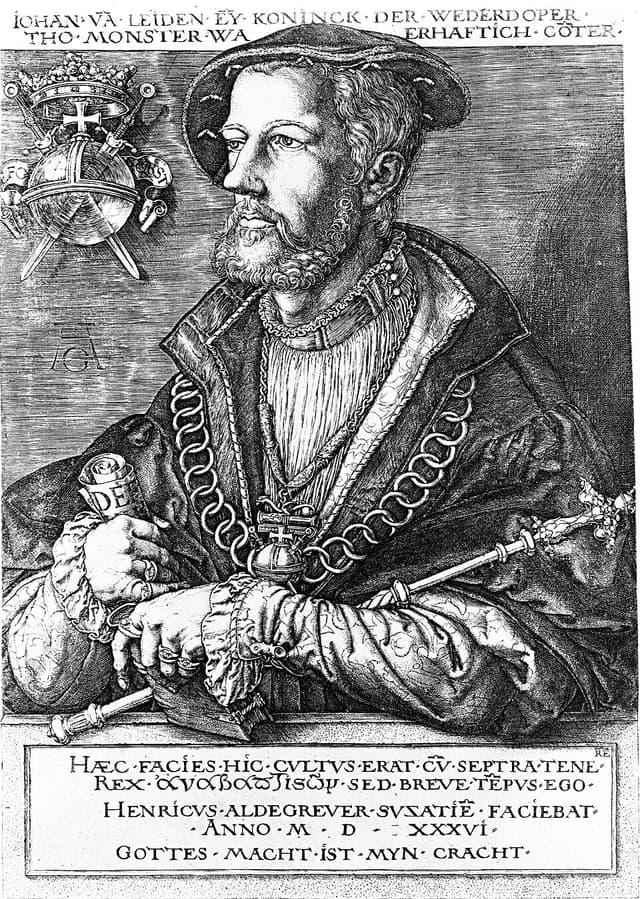
Heinrich Aldegrever, Public domain, via Wikimedia Commons
80/100
ACE Score: 80/100
High on the scale. An index, not a percentage.
80High
How total and coercive the leader’s power was.
80High
How devoted to and dependent on the leader followers became.
80High
How hard it was to leave.
(rule-based):Pattern: a closed system with little institutional restraint, where harm was aimed mainly at its own people. A label for these scores, not a forecast. The summary and caveats describe what actually happened.
Scores are an interpretation of published sources using the ACE scoring guide, not findings of fact. Inclusion does not classify anyone as a cult. Disclaimer
Jan Bockelson of Leiden was a Dutch tailor and Anabaptist preacher who came to Münster in January 1534, weeks before Anabaptists won control of the city council in February. When the prophet Jan Matthys died in a sortie at Easter 1534, Jan took control, abolished private property, introduced compulsory polygamy and had himself crowned king of the New Jerusalem. The prince-bishop's army besieged the city, which starved until it fell in June 1535. Jan was tortured and executed in January 1536, and his body was hung in an iron cage from St Lambert's Church.
In academic terms, münster combines extreme spatial and temporal closure: a sealed city waiting for an imminent end. The violence ran mostly inward, against dissenting residents, alongside the siege that killed many inhabitants.
Where scholars disagree
The case that the framework fits
A self-proclaimed prophet-king ruled a closed city through revelation, controlled marriage and property, executed critics and promised imminent deliverance. This is close to the classic pattern of a millenarian cult under siege.
The case that it does not fit, or overstates
Historians of the city note that the siege itself drove much of the radicalisation and that Münster grew out of an urban Reformation and guild politics, not just one leader. Haude shows how hostile pamphlets across the Empire shaped Münster's image. Most sources are hostile Catholic and Lutheran accounts written after the defeat, so the worst details may be exaggerated.
The five walls
8.2 of 10
- 8
1.
Who decides what is real?
Jan claimed direct revelation and ruled through prophetic decrees. Books other than the Bible were reportedly burned, and dissent was treated as a capital crime.
- 7
2.
Are friends and family outside the group cut off?
Residents who refused rebaptism were expelled in February 1534, splitting families. Polygamy was imposed in mid-1534 and unmarried women were required to take husbands.
- 9
3.
How hard is it to physically leave?
The city was under siege and residents could not leave freely; flight was punished inside the walls, and many who escaped were killed by the besiegers. Near the end some starving civilians were let out.
- 9
4.
Is an apocalypse or a destined triumph always near?
Jan Matthys set Easter 1534 as the day of judgement, and Jan of Leiden repeatedly promised imminent deliverance. Daily life was organised around the coming end.
- 8
5.
Does the group decide who deserves to live?
The armed revolt of Heinrich Mollenhecke against polygamy in July 1534 was crushed and dozens of participants were executed. Jan is reported to have beheaded one of his wives, Elisabeth Wandscherer, in public, though this story may have grown after his death.
Debt, dependence and harm
8 of 10, high
How much do followers feel they owe?
Private property and money were abolished, and residents surrendered gold, silver and goods to a common store. Survival depended on the leadership's food distribution during the siege.
7 of 10, high
How far does everything rest on one person?
Jan replaced the council with twelve elders and then a royal court with officials, but all of it rested on his prophetic claims. The kingdom ended with the city's fall.
-4, mostly insiders
When the system turns violent, where does the harm go?
Executions of dissenters and famine fell mainly on the city's own residents. Raids against the besieging army killed some outsiders, and the besiegers carried out a massacre when the city fell.
Methods of control
Specific techniques from the historical record that kept followers loyal and the bubble sealed.
- 01Expulsion of non-believers and rebaptism as the test of membership
- 02Abolition of private property
- 03Compulsory polygamy and control of marriage
- 04Public executions of dissenters
- 05Prophetic decrees and a crowned kingship
- 06Promises of imminent divine deliverance during siege
Against the reference cases
State power, violence aimed outward
Compared with Hitler
Both promised a new order and ruled by terror, but Münster was a single besieged city and its violence was mainly inward.
A sealed group, violence aimed inward
Compared with Jones
Münster resembles Jonestown in its sealed setting, total economic dependence and leader's sexual privileges, though death came mainly through siege and famine rather than a planned mass suicide.
Through the theorists
Jan's authority was pure charisma, briefly dressed in royal ceremony, and it could not outlive the defeat.
Cohn sees Münster as the climax of medieval revolutionary millenarianism, where an elite of saints claimed the right to purge the world.
Münster shows 'sacred science' and 'dispensing of existence': doctrine above question and dissenters treated as unfit to live.
Key sources
Moderate evidence base
- Cohn, Norman (1957). The Pursuit of the Millennium.
- Haude, Sigrun (2000). In the Shadow of 'Savage Wolves': Anabaptist Münster and the German Reformation during the 1530s.
- Kerssenbrock, Hermann von (trans. Christopher S. Mackay) (2007). Narrative of the Anabaptist Madness: The Overthrow of Münster, the Famous Metropolis of Westphalia.
Caveats
Main narratives come from Kerssenbrock, a Catholic schoolmaster writing later, and from Heinrich Gresbeck, a defector. Both are hostile. Scores reflect the siege year 1534 to 1535, when control was at its peak.
Cite this profile
Koziol, T. (2026). Jan of Leiden. In ACE: Authority, Cult & Exit (Version 1.1, pilot database). Ceraluna Labs. https://cultornot.com/leader/jan-of-leiden