From the ACE database. Researched and checked against published sources.
George Lincoln Rockwell
1918 to 1967, founder and leader of the American Nazi Party, based in Arlington, Virginia
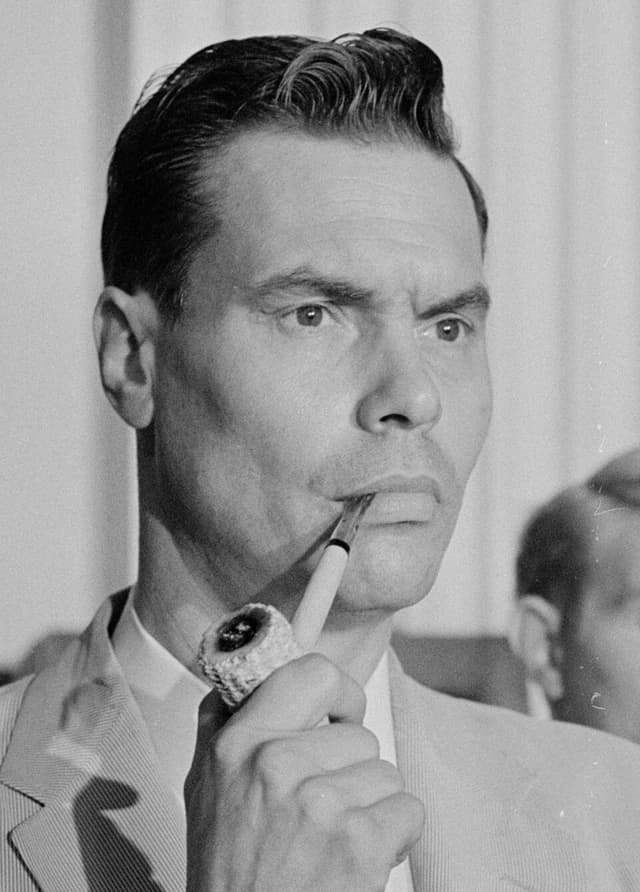
Warren K. Leffler, Public domain, via Wikimedia Commons
50/100
ACE Score: 50/100
Medium on the scale. An index, not a percentage.
50Medium
How total and coercive the leader’s power was.
60Medium
How devoted to and dependent on the leader followers became.
40Medium
How hard it was to leave.
(rule-based):Pattern: walls low enough (Bubble Score under 5) for followers to leave fairly easily. A label for these scores, not a forecast. The summary and caveats describe what actually happened.
Scores are an interpretation of published sources using the ACE scoring guide, not findings of fact. Inclusion does not classify anyone as a cult. Disclaimer
Rockwell was a former US Navy pilot who founded the American Nazi Party in 1959. The party openly used Nazi uniforms and symbols and staged provocative public stunts to gain media attention. Its active core was small, and a few dozen 'stormtroopers' lived at its headquarters in Arlington, Virginia, often in poverty. Rockwell was shot dead in 1967 by John Patler, a former member he had expelled.
In academic terms, rockwell ran a small, publicity-driven sect with moderate closure in its barracks core but little organised lethal violence; its main legacy was in shaping later white-power movements.
Where scholars disagree
The case that the framework fits
Simonelli shows Rockwell as the centre of a small sect whose members depended on him for housing, money and identity.
The case that it does not fit, or overstates
Schmaltz and Simonelli also show a party run on publicity stunts with high turnover, where members came and went freely, more like a fringe political party than a closed group.
The five walls
4.8 of 10
- 5
1.
Who decides what is real?
Rockwell's statements were the party line and mainstream media were denounced as Jewish-controlled, but members lived in open American society with free access to information.
- 4
2.
Are friends and family outside the group cut off?
Members at the barracks gave the party priority over family and jobs, but the party did not systematically sever outside ties.
- 4
3.
How hard is it to physically leave?
Core members lived in group housing at party headquarters with little money, but could and often did leave.
- 6
4.
Is an apocalypse or a destined triumph always near?
Rockwell predicted a coming racial crisis and claimed he would win the presidency in 1972, framing politics as a final struggle.
- 5
5.
Does the group decide who deserves to live?
Jews and Black Americans were dehumanised in party doctrine, and members harassed and assaulted opponents, but there is little evidence of party-ordered killings.
Debt, dependence and harm
5 of 10, medium
How much do followers feel they owe?
Barracks members worked for the party for little or no pay and depended on it for food and housing.
7 of 10, high
How far does everything rest on one person?
The party had ranks and units, but it splintered after Rockwell's death despite Matt Koehl taking over.
+2, mostly outsiders
When the system turns violent, where does the harm go?
Violence was mainly street fights and harassment of outsiders; Rockwell's own murder by an expelled member points inward, so the net is slightly outward.
Methods of control
Specific techniques from the historical record that kept followers loyal and the bubble sealed.
- 01Barracks living at headquarters
- 02Nazi uniforms and ritual
- 03Publicity stunts to attract media
- 04Dependence on the party for food and housing
- 05Expulsion of dissenters
- 06Race-war rhetoric
Against the reference cases
State power, violence aimed outward
Compared with Hitler
Rockwell copied Hitler's symbols and ideology but led a fringe group of a few hundred at most.
A sealed group, violence aimed inward
Compared with Jones
Unlike Jones, Rockwell lacked the means to seal followers off, and his group had little internal violence apart from his own murder.
Through the theorists
Rockwell's authority was personal and did not survive him; the party fragmented quickly.
Lewis Coser
The barracks resembles Coser's 'greedy institution', claiming members' whole lives in return for belonging.
Kathleen Belew
Belew's history places Rockwell's era as a precursor to the later, more violent white-power movement.
Key sources
Moderate evidence base
- Simonelli, Frederick J. (1999). American Fuehrer: George Lincoln Rockwell and the American Nazi Party.
- Schmaltz, William H. (1999). Hate: George Lincoln Rockwell and the American Nazi Party.
Caveats
Party membership figures were inflated by Rockwell and are hard to verify. Much evidence comes from FBI files and press coverage.
Cite this profile
Koziol, T. (2026). George Lincoln Rockwell. In ACE: Authority, Cult & Exit (Version 1.1, pilot database). Ceraluna Labs. https://cultornot.com/leader/george-lincoln-rockwell