From the ACE database. Researched and checked against published sources.
Fidel Castro
1926 to 2016, revolutionary leader who ruled Cuba from 1959 until handing power to his brother Raúl in 2006 to 2008
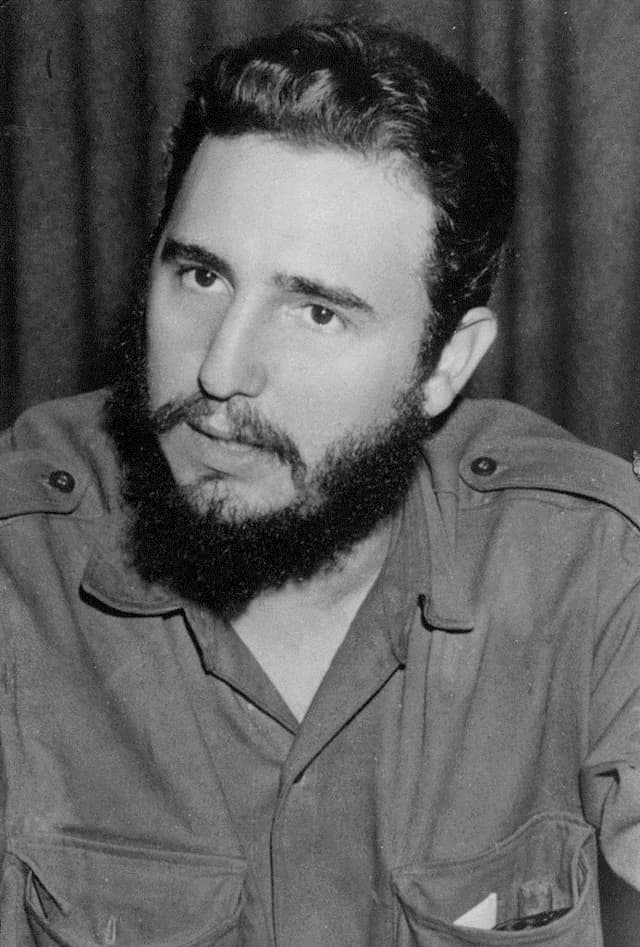
Unknown (Mondadori Publishers), Public domain, via Wikimedia Commons
62/100
ACE Score: 62/100
Medium on the scale. An index, not a percentage.
70High
How total and coercive the leader’s power was.
50Medium
How devoted to and dependent on the leader followers became.
65Medium
How hard it was to leave.
(rule-based):Pattern: a closed system with strong offices, rules and succession. A label for these scores, not a forecast. The summary and caveats describe what actually happened.
Scores are an interpretation of published sources using the ACE scoring guide, not findings of fact. Inclusion does not classify anyone as a cult. Disclaimer
Fidel Castro led a guerrilla war that toppled the Batista dictatorship in 1959. He turned Cuba into a one-party communist state allied with the Soviet Union and ruled for almost fifty years. His government expanded literacy and health care but banned opposition parties, controlled all media and jailed thousands of political prisoners. Neighbourhood committees watched daily life, and leaving the country required state permission. Over a million Cubans emigrated, many by boat.
In academic terms, castro bound citizens through revolutionary redemption, constant mobilisation against an external enemy and state control of exit, producing high spatial and epistemic closure with moderate existential violence and a successful transfer of power.
Where scholars disagree
The case that the framework fits
Guerra and others document a leader cult, total media control, labour camps, a ban on free exit and a revolutionary language of redemption and betrayal.
The case that it does not fit, or overstates
Supporters and many historians point to mass literacy, universal health care, real popular support in the early years and decades of US hostility, including invasion and assassination plots. Lethal violence was far lower than in Stalin's USSR or Mao's China.
The five walls
6.4 of 10
- 7
1.
Who decides what is real?
All newspapers, radio and television came under state control by 1960, and critical writers were punished, as when the poet Heberto Padilla was jailed in 1971 and made to read a public self-criticism. Lillian Guerra shows how dissent was cast as betrayal of the revolution.
- 6
2.
Are friends and family outside the group cut off?
Committees for the Defence of the Revolution, founded in 1960, organised surveillance on every block. Families were split by emigration, and those leaving were denounced as 'gusanos' (worms) and sometimes targeted by organised mobs in 'acts of repudiation'.
- 7
3.
How hard is it to physically leave?
Cubans needed an exit permit to travel abroad until 2013, and unauthorised departure was a crime. The state periodically opened exits, as in the 1980 Mariel boatlift when about 125,000 people left.
- 5
4.
Is an apocalypse or a destined triumph always near?
Slogans such as 'Patria o muerte' (homeland or death) and 'Socialism or death' framed life as permanent struggle against US aggression. Mass mobilisations and militia drills kept the sense of siege alive.
- 7
5.
Does the group decide who deserves to live?
Revolutionary tribunals executed several hundred people in 1959 alone, and totals over the following decades are disputed, with estimates running from a few thousand to far higher figures from exile groups. From 1965 to 1968 gay men, religious believers and others were sent to forced-labour camps known as UMAP.
Debt, dependence and harm
6 of 10, medium
How much do followers feel they owe?
Nearly all jobs, housing and food rations came through the state, and access often depended on political reliability. Citizens were expected to join mass organisations, attend rallies and do 'voluntary' labour.
4 of 10, medium
How far does everything rest on one person?
The Communist Party of Cuba was formally founded in 1965 and a socialist constitution was adopted in 1976. Power passed in an orderly way to Raúl Castro in 2006 to 2008, though within the family.
+4, mostly outsiders
When the system turns violent, where does the harm go?
Outward: most killings fell on people the regime defined as enemies, through firing squads for political opponents and the campaign against armed rebels in the Escambray mountains in the early 1960s. Inward: Cubans trying to leave were killed, as in the July 1994 sinking of the tugboat '13 de Marzo' by state boats, in which about 37 people died, and General Arnaldo Ochoa was executed in 1989.
Methods of control
Specific techniques from the historical record that kept followers loyal and the bubble sealed.
- 01Block-level surveillance through the Committees for the Defence of the Revolution
- 02State monopoly on media, education and employment
- 03Exit permits and labelling emigrants as traitors
- 04Mass rallies and long public speeches building a personal bond with Castro
- 05Labour camps and long prison terms for dissidents
- 06Framing the US embargo as permanent existential threat
Against the reference cases
State power, violence aimed outward
Compared with Hitler
Both built a heroic leader cult and mass mobilisation, but Castro did not pursue genocide and his killings were far fewer.
A sealed group, violence aimed inward
Compared with Jones
Jones admired the Cuban revolution, and both used siege mentality and control of exit, but Castro kept a functioning state and never sought the death of his followers.
Through the theorists
Castro's guerrilla charisma was steadily routinised into party and state offices, allowing a planned succession.
Albert Hirschman
Periodic mass emigration acted as a safety valve: letting critics exit reduced internal voice and helped the regime survive.
Lillian Guerra
Guerra shows the revolution as a 'grand narrative of redemption' that asked Cubans to prove loyalty constantly, making doubt a moral failing.
Key sources
Moderate evidence base
- Guerra, Lillian (2012). Visions of Power in Cuba: Revolution, Redemption, and Resistance, 1959–1971.
- Szulc, Tad (1986). Fidel: A Critical Portrait.
Caveats
Execution and prisoner counts come partly from exile organisations and are disputed. Closure was highest in the 1960s and eased somewhat later, especially for religion after the 1990s. Szulc's biography predates the post-Soviet period. Debate about Castro is strongly shaped by Cold War politics on both sides. As with the GDR, people killed while trying to leave count as inward, because the regime claimed them as its own citizens; thousands more drowned at sea, but those deaths were not direct state killings and are not scored. The net remains outward.
Cite this profile
Koziol, T. (2026). Fidel Castro. In ACE: Authority, Cult & Exit (Version 1.1, pilot database). Ceraluna Labs. https://cultornot.com/leader/fidel-castro