From the ACE database. Researched and checked against published sources.
Father Divine
about 1879 to 1965, Peace Mission Movement, active in Sayville and Harlem in New York and later in the Philadelphia area
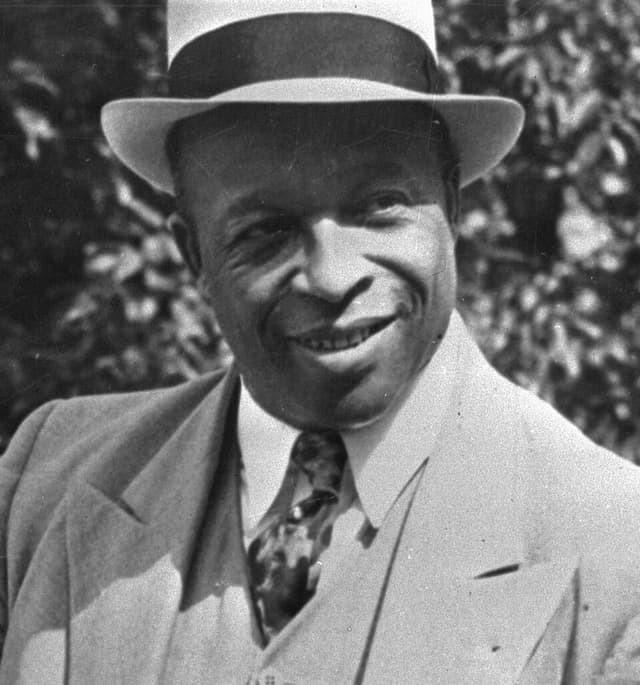
Los Angeles Times, CC BY 4.0, via Wikimedia Commons
38/100
ACE Score: 38/100
Low on the scale. An index, not a percentage.
25Low
How total and coercive the leader’s power was.
43Medium
How devoted to and dependent on the leader followers became.
45Medium
How hard it was to leave.
(rule-based):Pattern: walls low enough (Bubble Score under 5) for followers to leave fairly easily. A label for these scores, not a forecast. The summary and caveats describe what actually happened.
Scores are an interpretation of published sources using the ACE scoring guide, not findings of fact. Inclusion does not classify anyone as a cult. Disclaimer
Born George Baker, Father Divine built a racially integrated movement whose followers believed he was God. From the 1930s members lived in communal hotels called 'heavens', worked in movement businesses and were served large free banquets during the Depression. Members were required to be celibate, even married couples, and took new spiritual names. The movement campaigned against lynching and segregation, and it outlived him under his second wife, Mother Divine.
In academic terms, the Peace Mission shows high social closure through celibacy and renamed identities, combined with low spatial, temporal and existential closure. Devotion debt came through labour and pooled income rather than coercion, and a functioning succession limited leader dependence.
Where scholars disagree
The case that the framework fits
Celibacy imposed on married couples, new names and the claim to divinity look like classic tools for dissolving prior loyalties and binding members to one leader. The Verinda Brown case shows that money given could be hard to recover.
The case that it does not fit, or overstates
Watts and Weisbrot both stress that the movement fed and employed thousands during the Depression and fought racial discrimination. Members could and did leave, outsiders were not demonised, and many scholars treat it as a social reform church rather than a cult.
The five walls
3.4 of 10
- 4
1.
Who decides what is real?
Followers treated Father Divine's words as divine and recorded his sermons in the movement's own papers. Outside news was freely available, and his political platform engaged openly with public debates on race and law.
- 6
2.
Are friends and family outside the group cut off?
Members, including married couples, were required to live celibately and were housed by sex in separate quarters. Converts took new spiritual names and were taught to set aside earthly family ties in favour of the movement family.
- 3
3.
How hard is it to physically leave?
Communal 'heavens' were common but membership was voluntary, and many followers lived and worked outside them. Defectors such as Verinda Brown left and sued the movement in court.
- 3
4.
Is an apocalypse or a destined triumph always near?
Divine taught that heaven was being realised on earth now and that true believers need not die. There was no dated end and little catastrophic framing.
- 1
5.
Does the group decide who deserves to live?
Outsiders were not dehumanised, and the movement preached racial equality and peace. Critics and defectors faced lawsuits and public hostility, but not threats of violence.
Debt, dependence and harm
5 of 10, medium
How much do followers feel they owe?
Residents worked in movement businesses for low or no wages and pooled resources, and some donated property or savings. In 1937 former follower Verinda Brown won a judgment for money she had given, which Divine refused to pay.
5 of 10, medium
How far does everything rest on one person?
The movement incorporated churches and ran a network of businesses with officials. After his death in 1965 Mother Divine led the movement for decades, though authority remained tied to belief in Father Divine's ongoing spiritual presence.
0, little harm, or balanced
When the system turns violent, where does the harm go?
No lethal violence is documented in either direction from the movement. The main harms alleged were financial and familial.
Methods of control
Specific techniques from the historical record that kept followers loyal and the bubble sealed.
- 01Claim to be God in the flesh
- 02Mandatory celibacy, including for married couples
- 03New spiritual names replacing family identity
- 04Communal residences segregated by sex
- 05Employment in movement-owned businesses
- 06Free banquets as ritual and recruitment
Against the reference cases
State power, violence aimed outward
Compared with Hitler
Unlike Hitler's racial state, Father Divine rejected the concept of race and used his authority for integration. The only shared feature is a leader treated as beyond question.
A sealed group, violence aimed inward
Compared with Jones
Jim Jones openly copied Father Divine's communal model and visited the Peace Mission. Father Divine never built a sealed compound, an armed guard or an apocalyptic narrative, which is where the two diverge sharply.
Through the theorists
A strong charismatic claim was partly routinised through incorporation and a widow-successor who presented herself as continuing his presence rather than replacing him.
Celibacy, renaming and communal property are textbook 'renunciation' and 'communion' commitment mechanisms that detach members from outside bonds.
Baer and Singer
As a Black urban religious movement, the Peace Mission can be read as a response to Depression poverty and racism that offered material security alongside spiritual meaning.
Key sources
Strong evidence base
- Watts, Jill (1992). God, Harlem U.S.A.: The Father Divine Story.
- Weisbrot, Robert (1983). Father Divine and the Struggle for Racial Equality.
Caveats
Membership estimates range from about 10,000 to claims of millions. Contemporary press coverage was often hostile and racially loaded, so Watts and Weisbrot are more reliable than newspaper accounts. Control was highest in the 1930s and 1940s.
Cite this profile
Koziol, T. (2026). Father Divine. In ACE: Authority, Cult & Exit (Version 1.1, pilot database). Ceraluna Labs. https://cultornot.com/leader/father-divine