From the ACE database. Researched and checked against published sources.
Erich Honecker
1912 to 1994, organiser of the Berlin Wall in 1961 and leader of East Germany from 1971 until removed by his Politburo in October 1989
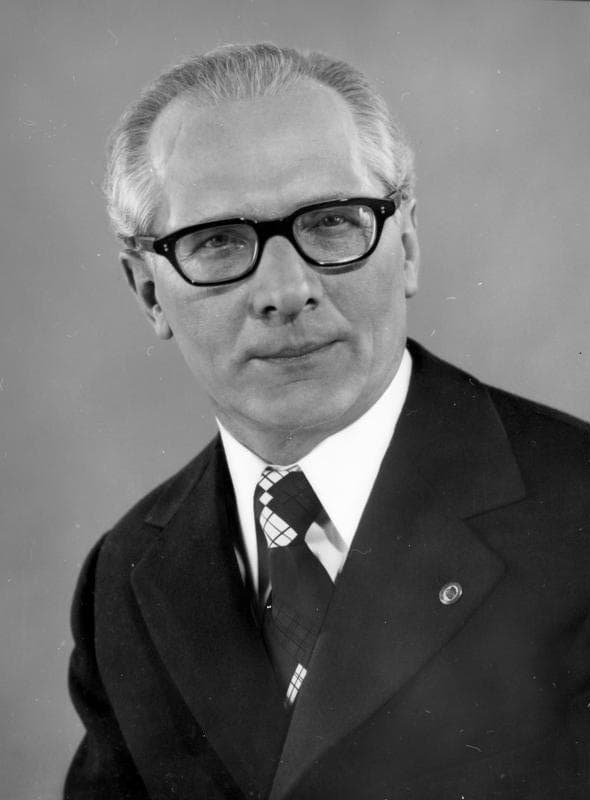
Unknown, CC BY-SA 3.0 de, via Wikimedia Commons
62/100
ACE Score: 62/100
Medium on the scale. An index, not a percentage.
65Medium
How total and coercive the leader’s power was.
47Medium
How devoted to and dependent on the leader followers became.
75High
How hard it was to leave.
(rule-based):Pattern: a closed system with strong offices, rules and succession. A label for these scores, not a forecast. The summary and caveats describe what actually happened.
Scores are an interpretation of published sources using the ACE scoring guide, not findings of fact. Inclusion does not classify anyone as a cult. Disclaimer
Erich Honecker, a communist jailed by the Nazis, organised the building of the Berlin Wall in 1961 as the party's security secretary. He led East Germany from 1971 until 1989. His state used the Stasi secret police and a huge network of informers to watch the population, and guards were ordered to stop escapes by force. At least 140 people died at the Berlin Wall between 1961 and 1989, and a 2017 study counted 327 deaths at the inner-German border. His own Politburo removed him in October 1989, weeks before the Wall fell.
In academic terms, honecker's GDR is the strongest case of spatial closure in this batch, combined with dense surveillance that turned citizens against one another, inside a bureaucracy that could replace its leader.
Where scholars disagree
The case that the framework fits
Mary Fulbrook and others describe a state that tried to know and shape every citizen through informers, ideological schooling and a sealed border.
The case that it does not fit, or overstates
Honecker had little personal charisma and the regime relied on bureaucracy rather than devotion. Fulbrook also stresses that many East Germans lived ordinary lives and took part in a 'participatory dictatorship' without seeing themselves as followers.
The five walls
6.4 of 10
- 7
1.
Who decides what is real?
The SED controlled all media, and critics faced prison or expulsion; the singer Wolf Biermann was stripped of citizenship in 1976 while on tour in the West. Most East Germans could watch West German television, so outside information was not sealed off.
- 6
2.
Are friends and family outside the group cut off?
The Stasi recruited around 189,000 unofficial informers by 1989, including people informing on spouses and friends. Children of some imprisoned escapees were placed for adoption against their parents' will.
- 9
3.
How hard is it to physically leave?
The Berlin Wall and the fortified inner-German border, with mines, SM-70 automatic firing devices until 1984 and orders to use firearms, kept citizens in. Applying to leave brought harassment and job loss.
- 4
4.
Is an apocalypse or a destined triumph always near?
Marxism-Leninism promised the inevitable victory of socialism, and the West was portrayed as a constant threat. This shaped schooling but not daily expectations of an end.
- 6
5.
Does the group decide who deserves to live?
Border guards shot people trying to escape: at least 140 died at the Berlin Wall between 1961 and 1989, and a Freie Universität Berlin study led by Klaus Schroeder counted 327 deaths at the inner-German border. From the 1970s the Stasi favoured 'Zersetzung', psychological destruction of dissidents, over killing.
Debt, dependence and harm
7 of 10, high
How much do followers feel they owe?
Careers, university places and housing depended on political reliability and party membership. Hundreds of thousands were drawn into complicity as informers.
3 of 10, low
How far does everything rest on one person?
The SED Politburo, Central Committee and state bureaucracy operated by rules, and Honecker had replaced Walter Ulbricht in 1971. In October 1989 the Politburo voted him out and replaced him with Egon Krenz.
-4, mostly insiders
When the system turns violent, where does the harm go?
Inward: most deaths were of the regime's own citizens shot, mined or drowned while trying to flee, several hundred in all. Outward: the GDR waged no wars and killed few people it defined as enemies; political opponents were mostly imprisoned, expelled or sold to West Germany rather than killed.
Methods of control
Specific techniques from the historical record that kept followers loyal and the bubble sealed.
- 01The Berlin Wall and fortified border with orders to fire
- 02Stasi surveillance and a mass informer network
- 03'Zersetzung' tactics to destroy dissidents' careers and relationships
- 04Control of education, jobs and housing by political reliability
- 05Selling political prisoners to West Germany for hard currency
- 06Ideological youth organisations (Free German Youth)
Against the reference cases
State power, violence aimed outward
Compared with Hitler
Honecker was himself a victim of Nazism and his state did not commit genocide, but it matched Nazi Germany in border control and surveillance.
A sealed group, violence aimed inward
Compared with Jones
Like Jones's settlement, the GDR made leaving physically dangerous, but it was a bureaucracy that removed its leader, not a group bound to one man.
Through the theorists
Honecker's authority was legal-rational and bureaucratic; his removal by vote shows how little the system depended on him personally.
Albert Hirschman
Hirschman's own essay on the GDR argues that blocking exit suppressed voice for decades, and that the mass exit of 1989 finally triggered voice and collapse.
Mary Fulbrook
Fulbrook's idea of a 'participatory dictatorship' highlights how ordinary people were drawn into running the system, which raises the debt score.
Key sources
Strong evidence base
- Fulbrook, Mary (1995). Anatomy of a Dictatorship: Inside the GDR, 1949–1989.
- Hertle, Hans-Hermann, and Maria Nooke (eds.) (2009). Die Todesopfer an der Berliner Mauer 1961–1989: Ein biographisches Handbuch.
Caveats
The GDR is extremely well documented thanks to opened Stasi files. Wall death counts depend on definitions: the 2009 Hertle and Nooke handbook documented 136 deaths, updated by the same project to at least 140 in 2017, and inner-border deaths are counted separately. Many Wall deaths came before Honecker became leader in 1971, though he organised the border regime from 1961. The regime called escape a crime against the state, but people killed while fleeing are scored as inward: they were citizens the regime claimed as its own and refused to let go, which matches the rubric's treatment of defectors. The same rule is applied to Cubans killed while fleeing Castro's Cuba.
Cite this profile
Koziol, T. (2026). Erich Honecker. In ACE: Authority, Cult & Exit (Version 1.1, pilot database). Ceraluna Labs. https://cultornot.com/leader/erich-honecker