From the ACE database. Researched and checked against published sources.
Ayn Rand
1905 to 1982, novelist and philosopher; the Collective met in New York from the early 1950s, and the Nathaniel Branden Institute ran from 1958 to 1968
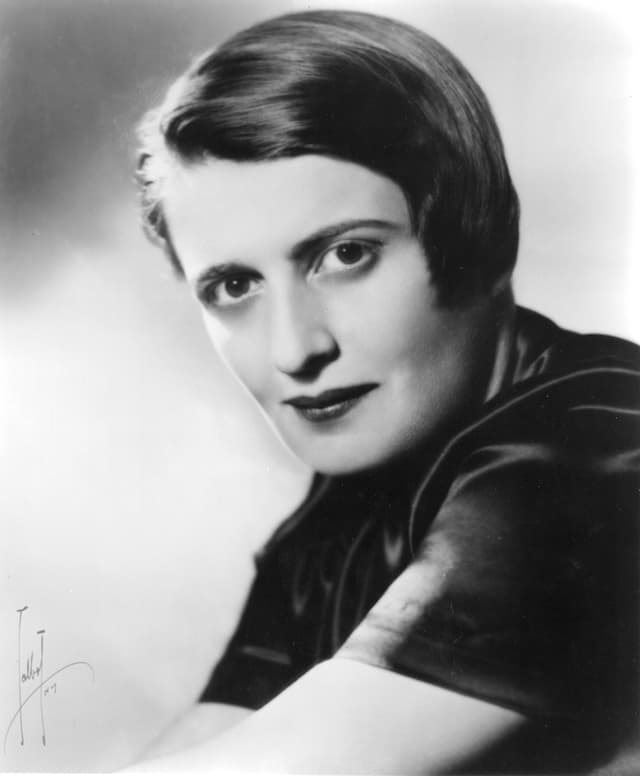
Photo portrait credited to "Talbot" (though not on original dust jac…, Public domain, via Wikimedia Commons
33/100
ACE Score: 33/100
Low on the scale. An index, not a percentage.
35Low
How total and coercive the leader’s power was.
40Medium
How devoted to and dependent on the leader followers became.
25Low
How hard it was to leave.
(rule-based):Pattern: walls low enough (Bubble Score under 5) for followers to leave fairly easily. A label for these scores, not a forecast. The summary and caveats describe what actually happened.
Scores are an interpretation of published sources using the ACE scoring guide, not findings of fact. Inclusion does not classify anyone as a cult. Disclaimer
Ayn Rand was a Russian-born American novelist whose books The Fountainhead and Atlas Shrugged set out her philosophy of Objectivism. In the 1950s a small group of admirers, including Nathaniel and Barbara Branden, Leonard Peikoff and Alan Greenspan, met with her weekly and called themselves 'the Collective'. The Nathaniel Branden Institute taught her ideas in lecture courses. Members who disagreed with Rand were often expelled and shunned, most dramatically Nathaniel Branden in 1968 after Rand learned he had hidden a relationship with another woman.
In academic terms, rand's inner circle shows moderate epistemic and social closure enforced by expulsion and shunning, with no spatial, temporal or violent closure; it is a case of intellectual orthodoxy rather than a residential cult.
Where scholars disagree
The case that the framework fits
Rothbard, Branden and Walker describe enforced orthodoxy, moral denunciation of dissenters, and a leader whose personal tastes became doctrine, all hallmarks of a cult of personality.
The case that it does not fit, or overstates
Defenders such as James Valliant argue that the Brandens' accounts are self-serving and unreliable, and others note that members lived independent lives, that the circle was small and voluntary, and that harsh breaks are common in intellectual movements without making them cults.
The five walls
2.6 of 10
- 5
1.
Who decides what is real?
Rand's judgments on philosophy, art and music were treated as binding, and members who doubted them were told they were irrational. Murray Rothbard broke with the circle in 1958 after a bitter dispute, and others were expelled over disagreements.
- 4
2.
Are friends and family outside the group cut off?
Rand asked Barbara Branden and her own husband, Frank O'Connor, to accept her affair with Nathaniel Branden, which began in 1954. After the 1968 split, followers were expected to cut ties with the Brandens.
- 1
3.
How hard is it to physically leave?
Members lived their own lives in New York and could leave at any time.
- 1
4.
Is an apocalypse or a destined triumph always near?
Atlas Shrugged pictures social collapse, but Objectivism had no expected end and no millennial programme.
- 2
5.
Does the group decide who deserves to live?
Rand called opponents evil and irrational and demanded that followers condemn them. Shunning was used, but there were no threats of violence.
Debt, dependence and harm
4 of 10, medium
How much do followers feel they owe?
Members invested years of time and emotional loyalty, and some faced public denunciation in The Objectivist. Livelihoods of NBI staff depended on Rand's approval.
7 of 10, high
How far does everything rest on one person?
The NBI collapsed when Rand broke with Branden in 1968, showing how much depended on her. After her death in 1982 Leonard Peikoff, her heir, founded the Ayn Rand Institute in 1985.
0, little harm, or balanced
When the system turns violent, where does the harm go?
No violence is documented.
Methods of control
Specific techniques from the historical record that kept followers loyal and the bubble sealed.
- 01Treating the leader's judgments as objective truth
- 02Labelling doubt as irrationality
- 03Expulsion and public denunciation of dissenters
- 04Shunning of expelled members
- 05Lecture courses as a formal teaching pipeline
- 06Small inner circle with special status
Against the reference cases
State power, violence aimed outward
Compared with Hitler
Rand opposed all collectivism and had no state power; the overlap is only the personal loyalty she expected.
A sealed group, violence aimed inward
Compared with Jones
Unlike Jones she held no property, homes or bodies of followers; control was purely intellectual and emotional.
Through the theorists
Charisma resting on intellectual authority, with weak routinisation that broke when the leader's personal relationships failed.
Shows 'doctrine over person' and 'loading the language', but without milieu control.
Rothbard
His 1972 essay 'The Sociology of the Ayn Rand Cult' argued the circle functioned as a cult while preaching individualism.
Key sources
Strong evidence base
- Burns, Jennifer (2009). Goddess of the Market: Ayn Rand and the American Right.
- Heller, Anne C. (2009). Ayn Rand and the World She Made.
- Branden, Nathaniel (1999). My Years with Ayn Rand.
Caveats
Branden's and Rothbard's accounts come from expelled members with grievances. Closure was highest from about 1958 to 1968. 'Cult' language here is contested even among critics.
Cite this profile
Koziol, T. (2026). Ayn Rand. In ACE: Authority, Cult & Exit (Version 1.1, pilot database). Ceraluna Labs. https://cultornot.com/leader/ayn-rand