From the ACE database. Researched and checked against published sources.
Ante Pavelić
1889 to 1959, founder of the Ustaša movement and head (Poglavnik) of the Axis-backed Independent State of Croatia
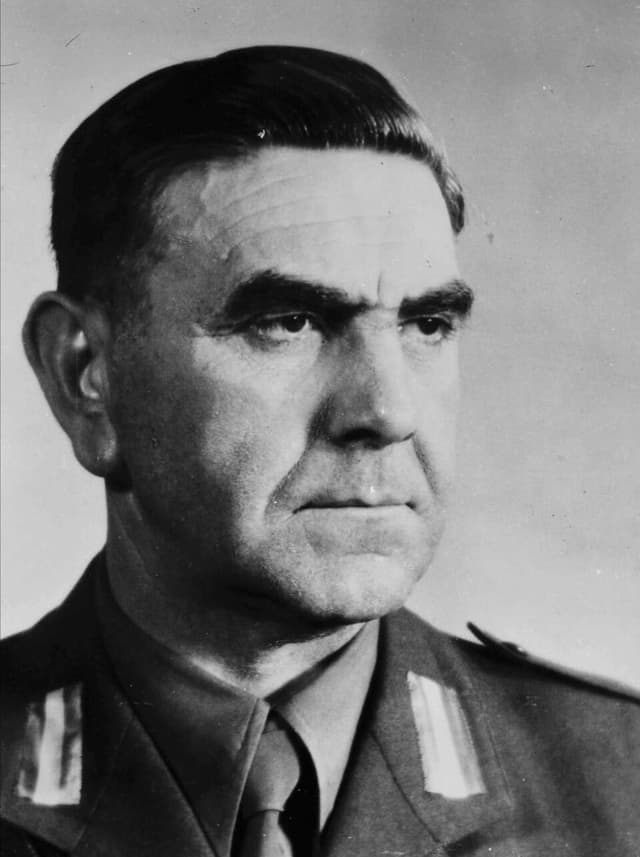
Willy Pragher, CC BY 3.0 de, via Wikimedia Commons
74/100
ACE Score: 74/100
High on the scale. An index, not a percentage.
90High
How total and coercive the leader’s power was.
67Medium
How devoted to and dependent on the leader followers became.
65Medium
How hard it was to leave.
(rule-based):Pattern: a closed system with little institutional restraint, where harm was aimed mainly at outsiders. A label for these scores, not a forecast. The summary and caveats describe what actually happened.
Scores are an interpretation of published sources using the ACE scoring guide, not findings of fact. Inclusion does not classify anyone as a cult. Disclaimer
Ante Pavelić founded the Ustaša, a Croatian fascist and terrorist movement, in exile in Italy. After the Axis invasion of Yugoslavia in 1941, Germany and Italy installed him as leader of the Independent State of Croatia, which also covered Bosnia. His regime carried out genocide against Serbs, Jews and Roma, killing hundreds of thousands in massacres and camps such as Jasenovac. When the Axis lost, he fled and later lived in Argentina and Spain, where he died in 1959.
In academic terms, pavelić combined maximal existential violence against outsiders with a palingenetic national myth and a leader principle, in a puppet state with almost no independent institutions.
Where scholars disagree
The case that the framework fits
Historians such as Rory Yeomans and Jozo Tomasevich show a fascist movement with a leader cult, a myth of national rebirth and organised genocide.
The case that it does not fit, or overstates
Some scholars stress that the Ustaša had narrow popular support and depended on Axis troops, so Pavelić never commanded the mass devotion of a Hitler. A minority of nationalist writers have tried to minimise the crimes, a view rejected by mainstream historians.
The five walls
7.4 of 10
- 8
1.
Who decides what is real?
The Ustaša banned opposition parties and press and ran propaganda through schools, youth groups and the Catholic and Muslim press that supported it. Criticism was treated as treason under special courts.
- 6
2.
Are friends and family outside the group cut off?
Racial laws in 1941 stripped Jews, Serbs and Roma of rights, and forced conversions of Orthodox Serbs to Catholicism aimed to erase their identity. Mixed families were broken up by deportation and killing.
- 7
3.
How hard is it to physically leave?
The regime ran a network of camps, including Jasenovac and Stara Gradiška, from which there was no exit for those targeted. Movement was controlled by permits in wartime conditions.
- 6
4.
Is an apocalypse or a destined triumph always near?
Ustaša ideology promised the rebirth of an ethnically pure Croatia and framed the war as a final reckoning with Serbs and Jews. It mixed this with Catholic and peasant symbolism.
- 10
5.
Does the group decide who deserves to live?
The US Holocaust Memorial Museum estimates that the regime murdered 320,000 to 340,000 Serbs and over 30,000 Croatian Jews, and that 77,000 to 99,000 people died at Jasenovac alone. Roma were also killed in large numbers.
Debt, dependence and harm
6 of 10, medium
How much do followers feel they owe?
Ustaša militia members swore an oath to the Poglavnik and were drawn into mass killings. Officials and citizens gained property seized from murdered or deported Serbs and Jews.
8 of 10, high
How far does everything rest on one person?
The state rested on Pavelić's personal leadership and on German and Italian occupation forces. It collapsed with the Axis defeat in 1945 and had no succession.
+10, mostly outsiders
When the system turns violent, where does the harm go?
Outward: the regime's violence was aimed at Serbs, Jews and Roma, whom it defined as enemies of the nation, and amounted to genocide; communists and anti-fascist Croats were also killed. Inward: purges of Ustaša members, such as the executions after the 1944 Lorković-Vokić plot, were minor by comparison.
Methods of control
Specific techniques from the historical record that kept followers loyal and the bubble sealed.
- 01Leader principle around the Poglavnik with oaths of loyalty
- 02Racial and religious laws defining enemies of the nation
- 03Concentration and death camps such as Jasenovac
- 04Forced conversion and expulsion of Orthodox Serbs
- 05Militia massacres in villages
- 06Redistributing victims' property to supporters
Against the reference cases
State power, violence aimed outward
Compared with Hitler
Pavelić is the closest case in this batch to Hitler: a fascist leader whose regime committed genocide, though on a smaller scale and as an Axis client.
A sealed group, violence aimed inward
Compared with Jones
Jones turned violence inward on his followers, while Pavelić aimed it almost entirely at people defined as outsiders to the nation.
Through the theorists
Pavelić claimed charismatic authority as Poglavnik, but his power depended on foreign backing more than on routinised offices.
Roger Griffin
The Ustaša fit Griffin's definition of fascism as palingenetic ultranationalism: a myth of national rebirth through purging enemies.
Emilio Gentile
Gentile's idea of fascism as a political religion fits Yeomans's account of Ustaša culture, with rituals, martyrs and youth movements that sacralised the nation and its leader.
Key sources
Strong evidence base
- Tomasevich, Jozo (2001). War and Revolution in Yugoslavia, 1941–1945: Occupation and Collaboration.
- Yeomans, Rory (2013). Visions of Annihilation: The Ustasha Regime and the Cultural Politics of Fascism, 1941–1945.
Caveats
Victim numbers for the NDH, and especially Jasenovac, were inflated in some Yugoslav-era accounts and minimised in some Croatian nationalist ones; the USHMM ranges used here reflect current scholarly consensus. The regime lasted only four years and was shaped by war and occupation.
Cite this profile
Koziol, T. (2026). Ante Pavelić. In ACE: Authority, Cult & Exit (Version 1.1, pilot database). Ceraluna Labs. https://cultornot.com/leader/ante-pavelic